If your air conditioner seems to run constantly during a Central Texas summer, you may start looking at every part of your home that could be contributing to the problem. Your attic, windows, doors, and insulation are common places to investigate. But what about your siding?
Replacing old or damaged siding can improve the condition and appearance of your home's exterior. It can also create an opportunity to address problems with the wall assembly. But does new siding automatically lower your energy bill?
Not necessarily. The siding material itself is usually not the primary source of a home's thermal insulation. What matters is the complete wall system behind it, including the insulation, air-control layers, weather-resistant barrier, and installation details.
For homeowners considering siding replacement in Austin and the surrounding areas, understanding these differences can help you make a more informed investment.
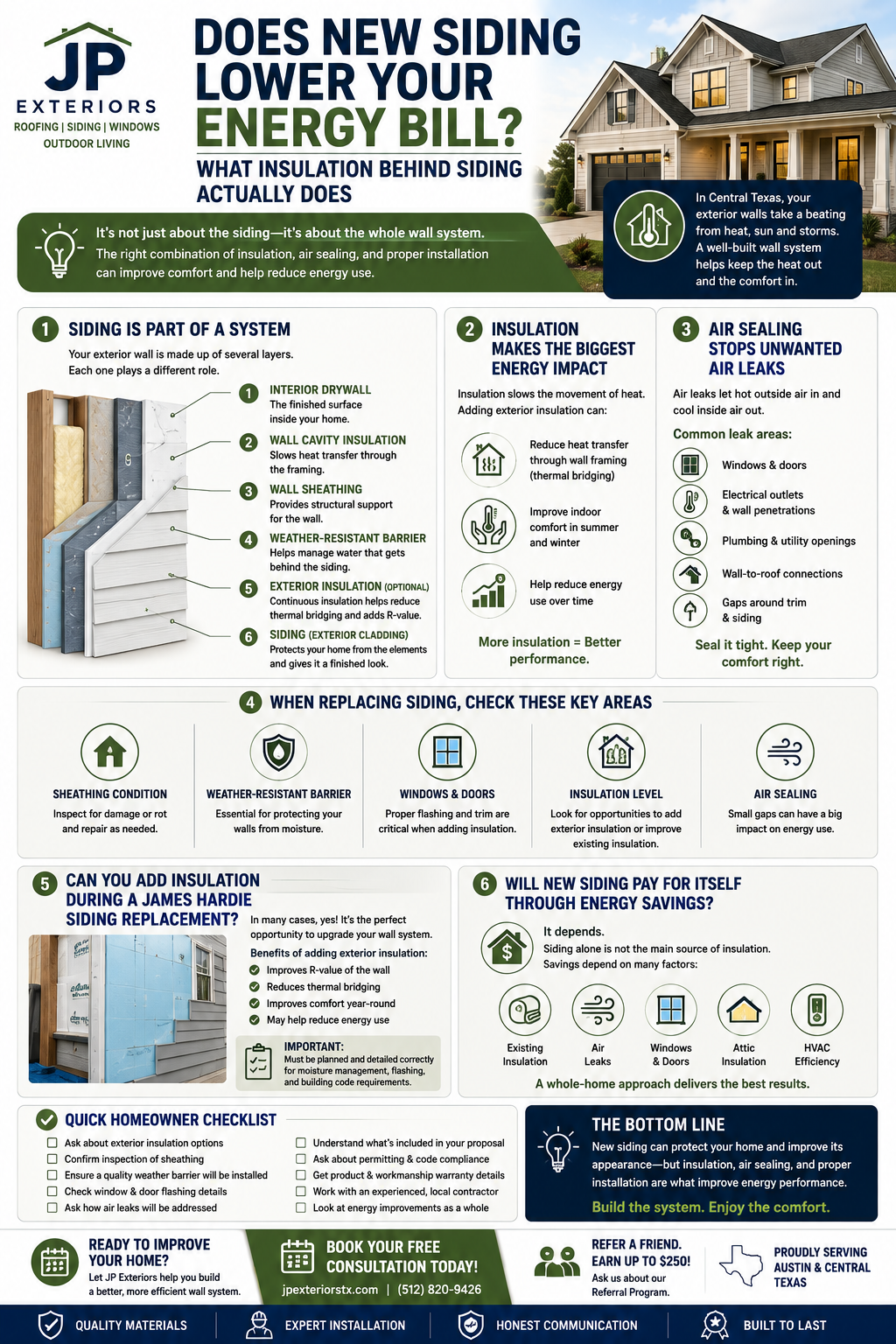
1. Does Siding Actually Insulate Your Home?
Siding is the exterior finish attached to your home's walls. Its primary jobs are to protect the structure from the elements, provide a finished appearance, and work with the layers behind it to manage moisture.
Some siding products have insulating properties or are installed as part of an insulated assembly. However, traditional fiber cement siding, including James Hardie products, should not be treated as a substitute for wall insulation.
Think of your exterior wall as a system made up of several layers:
Interior drywall: The finished surface inside your home.
Wall cavity insulation: Insulation installed between wall studs, where present.
Wall sheathing: The structural layer covering the framing.
Weather-resistant barrier: Helps manage water that gets behind the siding.
Optional exterior insulation: A continuous layer of insulation installed over the wall sheathing.
Siding: The exterior cladding that protects and finishes the wall.
Each layer serves a different purpose. Replacing the siding without addressing insulation or air leakage may improve the exterior without making a noticeable difference in energy use.
The U.S. Department of Energy's Building America resources explain how exterior insulation can improve wall performance by reducing heat transfer through framing and helping create a more continuous thermal layer.
2. Why Insulation Behind Siding Matters
Insulation slows the movement of heat through your home's walls. During a Texas summer, that means helping reduce the amount of outdoor heat that moves into conditioned living spaces.
One important concept is thermal bridging.
Your home's wall framing is made up of materials such as wood studs. Heat can move through those framing members more easily than through properly installed insulation in the spaces between them.
That means a wall can have insulation between its studs and still allow heat to move through the framing.
Continuous exterior insulation can help address this issue by adding a layer of insulation across the outside of the wall, reducing the thermal bridging effect.
Depending on the home's existing construction and the proposed wall assembly, adding exterior insulation during a siding replacement may be worth considering.
However, it is not a one-size-fits-all upgrade. The right approach depends on the existing wall, window and door details, moisture management, and the products being installed.
For more technical information, see the U.S. Department of Energy's guide to rigid foam insulation for existing exterior walls.
3. What About Air Leaks? They Matter More Than Many Homeowners Realize
Insulation and air sealing are related, but they are not the same thing.
Insulation slows heat transfer. Air sealing helps prevent unwanted air from moving through gaps and openings in the home's exterior envelope.
Air can leak around:
Window and door frames
Electrical outlets and exterior wall penetrations
Plumbing and utility openings
Wall-to-roof connections
Gaps around exterior trim
Cracks or openings in the wall assembly
Even a well-insulated wall can perform poorly if air is moving through gaps in the assembly.
This is one reason siding replacement should involve more than simply attaching new boards to the exterior. Once the old siding is removed, the condition of the underlying wall and existing weather-resistant layers can be evaluated.
The ENERGY STAR guide to sealing and insulating your home explains how air leakage and insufficient insulation can affect comfort and energy use.
4. What Should Be Checked When Replacing Siding?
A siding replacement project can provide an opportunity to examine areas that are normally hidden behind the exterior finish.
Before installing new siding, several details deserve attention.
Existing Sheathing
The sheathing is the layer attached to the exterior wall framing. It provides a surface for the wall assembly and may show signs of moisture damage, deterioration, or other issues.
If damaged sheathing is discovered, the affected areas may need to be repaired or replaced before the new siding goes on.
Weather-Resistant Barrier
A weather-resistant barrier, sometimes called house wrap, helps protect the wall from water that gets behind the siding.
It should be installed and integrated with flashing so that water can drain outward rather than becoming trapped inside the wall.
This is especially important around windows, doors, roof-to-wall transitions, and other openings.
The Building America Solution Center's drainage-plane guidance explains why proper drainage and flashing are essential parts of a durable exterior wall.
Window and Door Details
Adding exterior insulation can change the depth of the wall assembly. This may affect window and door trim, flashing, and how exterior fixtures attach to the wall.
These details should be considered before work begins rather than treated as last-minute adjustments.
Existing Insulation
A siding replacement does not automatically improve the insulation inside the wall cavities. If the home has missing, damaged, or insufficient insulation, that issue may require a separate solution.
A contractor can identify visible conditions during the project, but determining the insulation level inside a closed wall may require additional inspection.
5. Can You Add Insulation During a James Hardie Siding Replacement?
In some situations, yes.
When existing siding is removed, homeowners may have the opportunity to add continuous exterior insulation before the new siding is installed.
This can be particularly worth discussing when:
The home has older exterior wall construction.
The existing walls have little or no exterior insulation.
The homeowner is already planning a full siding replacement.
Improving indoor comfort is an important project goal.
The wall assembly can accommodate the added thickness and necessary detailing.
However, adding insulation is not simply a matter of placing foam boards on the wall and covering them with siding.
The contractor must account for:
The type and thickness of insulation.
Proper fastening and support for the selected siding.
Window and door trim extensions.
Flashing and water management.
Electrical fixtures, hose bibs, and other wall penetrations.
Manufacturer installation requirements and applicable building codes.
The Department of Energy's checklist for adding exterior insulation during re-siding provides additional guidance on the planning and installation considerations involved.
Not every home is a good candidate for the same insulation system. The existing construction should be evaluated before choosing an approach.
6. What Does This Mean for Austin and Central Texas Homes?
Central Texas homeowners deal with long periods of hot weather, strong sun, and substantial cooling demand.
When outdoor temperatures climb, the home's entire building envelope has to work together to keep indoor spaces comfortable.
That includes:
Attic insulation and ventilation.
Exterior wall insulation.
Window glass and frame performance.
Exterior door seals.
Air leakage around openings.
HVAC system condition and ductwork.
Replacing siding may be one part of improving the home's exterior performance, but it is rarely the only factor behind high energy bills.
For example, a home with good wall insulation but significant attic air leakage may still struggle to stay comfortable. Likewise, installing new siding over a wall with inadequate insulation will not automatically solve an indoor temperature problem.
The best approach is to identify where the home is losing energy before deciding which upgrades are worth the investment.
7. Will New Siding Pay for Itself Through Energy Savings?
This is where homeowners should be careful about promises.
A siding contractor should not guarantee a specific reduction in your utility bills simply because you install new siding.
The actual impact depends on several factors:
The home's age and original construction.
Existing wall insulation.
Air leakage throughout the home.
Whether exterior insulation is added.
Window and door performance.
Attic insulation and HVAC efficiency.
Installation quality and the home's overall condition.
ENERGY STAR discusses potential energy savings from air sealing and insulation improvements, but those estimates apply to specific improvement measures and assumptions. They should not be interpreted as a guaranteed savings figure for a siding replacement project.
You can review its guidance here: Why Seal and Insulate?.
For many homeowners, siding replacement is primarily an investment in protecting the home's exterior, addressing deterioration, and improving curb appeal. Energy-related improvements may be an additional benefit when the right insulation and air-sealing work is included.
8. What Should You Ask Before Starting a Siding Project?
If energy efficiency is one of your reasons for replacing siding, ask your contractor a few specific questions before signing a proposal.
Will the existing siding be completely removed?
Understanding the scope helps clarify whether the underlying wall can be inspected.Will the sheathing be inspected for damage?
Ask how damaged or deteriorated areas will be handled if discovered.What weather-resistant barrier will be installed?
Ask how it will be integrated with window, door, and wall flashing.Can exterior insulation be added to this wall assembly?
Ask whether the existing construction can accommodate it and what additional work would be required.How will windows, doors, and exterior fixtures be handled?
Added insulation can affect trim depth and other exterior details.What energy improvements are actually included in the proposal?
Make sure the estimate clearly separates siding replacement from insulation or air-sealing upgrades.
A clear proposal should explain what is included, what is optional, and what conditions could change the scope.
The Bottom Line: New Siding Is an Opportunity to Improve the Whole Wall System
New siding can make a major difference in the appearance and protection of your home, but it does not automatically make the home more energy efficient.
The insulation behind the siding, the condition of the wall sheathing, air leakage, flashing, and moisture management all contribute to how well the exterior wall performs.
If you're already planning to replace your siding, it may be a good time to evaluate whether additional insulation or other improvements make sense.
At JP Exteriors, we help homeowners throughout Austin and Central Texas with James Hardie fiber cement siding replacement and exterior remodeling. We can review the existing exterior, discuss the scope of the project, and help you understand which improvements may be appropriate for your home.
Get Started With a Free Roofing Consultation
Considering new siding or other exterior improvements? JP Exteriors can help you evaluate your home's exterior, discuss your options, and plan a project that fits your home's needs.
Frequently Asked Questions
Does replacing siding lower your electric bill?
It can contribute to improved energy performance if the project also addresses insulation or air leakage issues. Replacing the siding alone does not guarantee lower electric bills.
Does James Hardie siding provide insulation?
James Hardie fiber cement siding is an exterior cladding product, not a substitute for wall insulation. The insulation behind the siding is what provides most of the wall assembly's thermal resistance.
Can you add insulation without replacing the siding?
Sometimes, but the best method depends on the home's existing construction. Some insulation improvements can be completed from the interior, while exterior continuous insulation generally requires access to the outside wall assembly.
Is exterior foam insulation worth adding during siding replacement?
It may be worth considering when the existing wall has limited insulation or when improving thermal performance is a priority. The added cost, wall details, moisture management, and compatibility with the siding system should all be evaluated.
Will new siding make my home cooler in the summer?
New siding by itself may not noticeably change indoor temperatures. However, improvements to the insulation and air-control layers behind the siding can help reduce unwanted heat transfer and improve comfort.
How do I know whether my walls need more insulation?
A home energy assessment can help identify areas where insulation or air sealing may be needed. A contractor can also evaluate visible wall conditions during siding removal, although the insulation inside a closed wall may require additional investigation.
Remember: When you refer a friend or neighbor for windows, siding, roofing, or door replacement, you can earn up to $250 through the JP Exteriors Referral Program.
Subscribe to JP Exteriors's Blog


Comments