When homeowners inspect siding damage, they usually look for the obvious problems — cracked boards, peeling paint, missing caulk. But some of the most serious damage can start in a small, easily overlooked area where the roof meets an exterior wall. That's where kickout flashing matters.
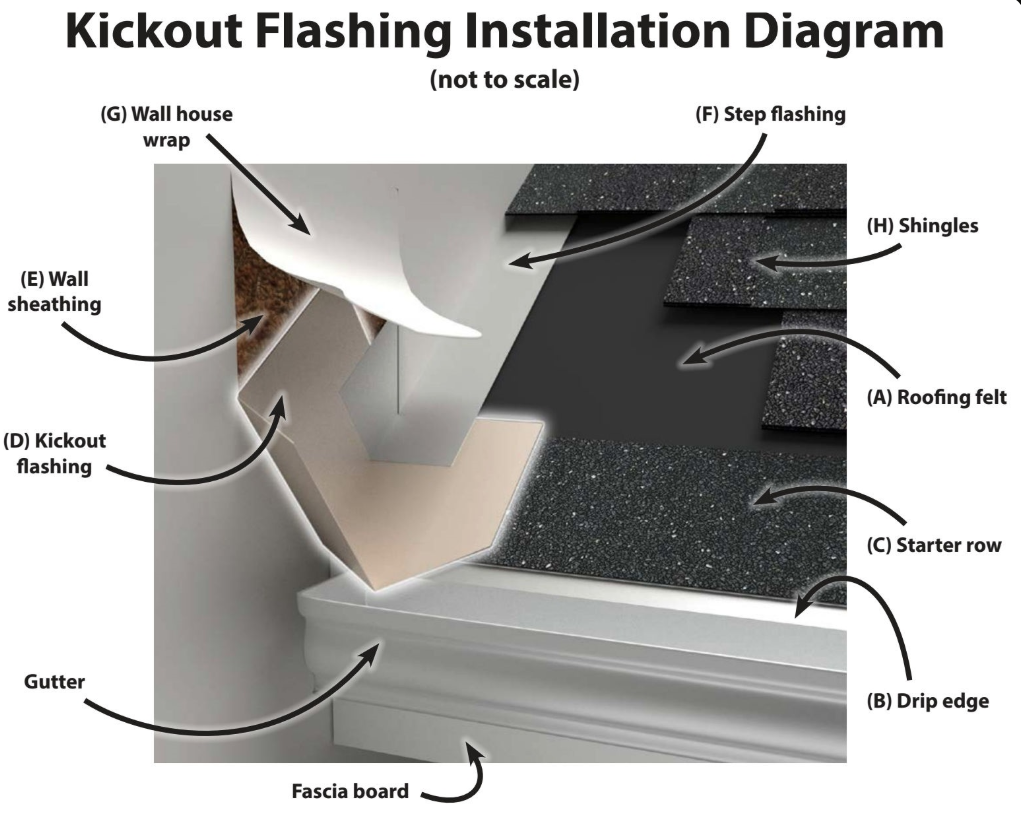
Kickout flashing is a small piece of metal or molded flashing installed at the lower end of a roof-to-wall intersection. Its job is to redirect water away from the wall and into the gutter system, instead of letting concentrated roof runoff spill behind the siding. It's one of the least noticeable parts of a roofing system, but when it's missing, incorrectly installed, or undersized for the amount of runoff it's handling, it can contribute to wet siding, rotten framing, damaged sheathing, and expensive repairs down the line.
Where Is Kickout Flashing Located?
Kickout flashing goes at the bottom of a sloped roof where that roof terminates against a vertical wall. You'll typically find this condition where a garage roof meets the side of a house, along a second-story wall, at a roof extension beside a taller exterior wall, where a lower roof meets siding, or near a roofline that drains toward a gutter running along the wall.
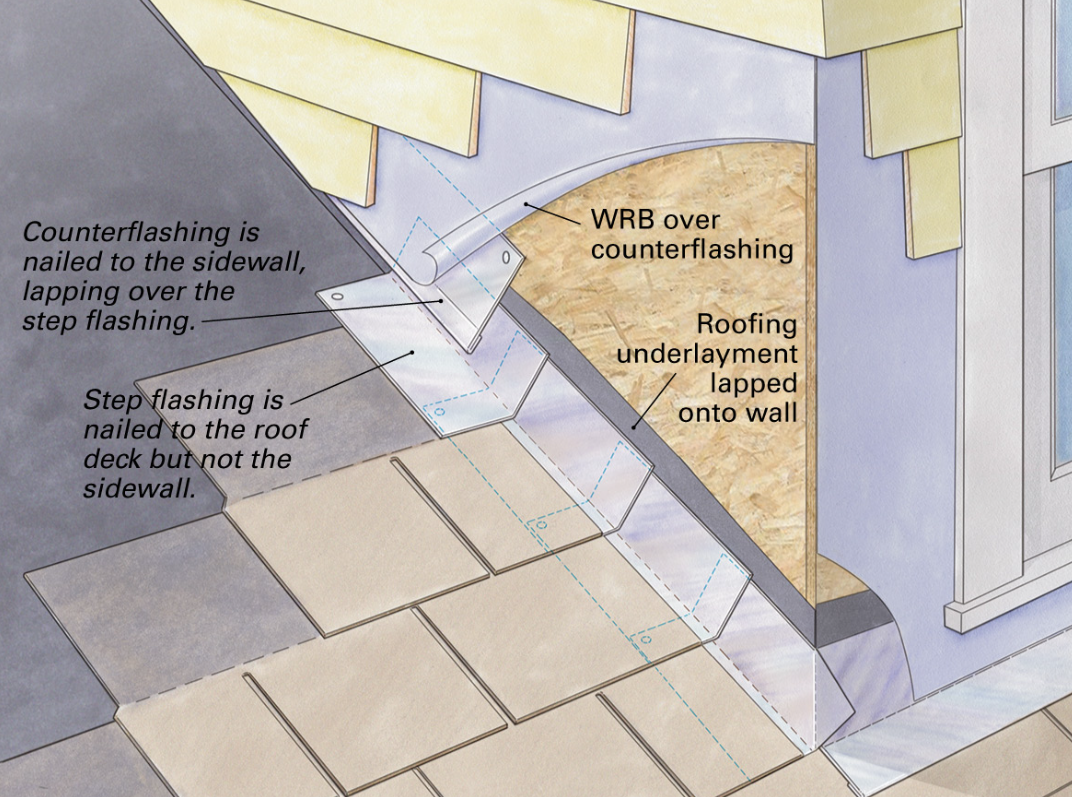
Water flows down the roof and toward that wall intersection. Step flashing protects the joint along the roof-to-wall connection itself, while kickout flashing redirects the water outward at the bottom of that intersection so it lands in the gutter instead of behind the siding. The two components work together — step flashing manages the transition, and kickout flashing handles moving the concentrated runoff away from the wall.
Why Does Missing Kickout Flashing Cause Damage?
A roof collects water from a large surface area, and at a roof-to-wall intersection, that water becomes concentrated into one narrow location. Without a properly installed kickout diverter, the water can run down the roof toward the wall, spill over or behind the siding, saturate the siding edge and trim, reach the sheathing and framing behind it, and cause swelling, staining, rot, or deterioration over time.
The siding itself may not show obvious damage right away. Some materials can conceal water intrusion for years, especially when the problem is happening behind the cladding rather than on its visible surface. That's exactly why a small exterior defect like this can turn into a much larger repair by the time it's actually discovered.
What Does Rotten Kickout Flashing Damage Look Like?
Damage varies depending on the siding material, how long the leak has been active, and whether the wall assembly has had time to dry between wet periods. Common warning signs include soft or swollen siding near a roof corner, dark staining beneath the roof-to-wall intersection, peeling or bubbling paint, caulk that keeps separating no matter how often it's redone, discolored trim, rot at the bottom edge of siding, swollen or deteriorated sheathing, soft wood around the corner or adjacent wall, water stains inside the home near the affected area, or mold-like growth and musty odors in enclosed wall spaces. Not every stain means there's a kickout flashing problem, and not every missing kickout has already caused structural damage — a qualified inspection is what actually determines the source and extent of the issue.
Why Austin Homes Are Especially Vulnerable to This Detail
Austin-area homes see intense rain events, including storms that dump a large amount of water in a short period of time. During heavy rain, roof runoff moves quickly toward roof-to-wall intersections, and if the flashing doesn't direct that water properly, the wall can receive far more water than it would during ordinary rainfall. This is especially relevant for homes with multiple roof levels, complex rooflines, tall walls beside lower roofs, narrow side-yard drainage areas, undersized or poorly aligned gutters, siding installed too close to the roof surface, or older construction with outdated flashing details. A properly sized kickout flashing should be able to handle the expected runoff and direct it into the gutter rather than onto the wall.
Kickout Flashing and the Gutter System Must Work Together
Kickout flashing isn't meant to solve every drainage problem on its own. The gutter it feeds into needs to be properly positioned, correctly pitched, free of blockages, sized appropriately for the roof area it serves, and connected to a functioning downspout system. If the gutter is missing, damaged, clogged, or installed too far from the kickout, water can still spill onto the siding regardless of how well the kickout itself was installed. And the reverse is true too — adding a bigger gutter doesn't automatically fix a missing or improperly integrated kickout flashing. The roof, flashing, siding, and gutter all have to work together as one coordinated drainage system.
What Proper Installation Actually Involves
Kickout flashing isn't simply a decorative piece of metal attached to the outside of the siding — it has to be integrated with the surrounding roof and wall layers. Depending on the existing construction, proper work can involve removing siding near the roof-wall intersection, inspecting the existing step flashing, checking the wall sheathing and framing for damage, repairing any deteriorated materials found, installing or correcting the water-resistive barrier, installing step flashing in the correct sequence, adding a properly sized kickout diverter, integrating the flashing with the roof underlayment, reinstalling siding with the required clearances, and connecting the kickout to the gutter system. The U.S. Department of Energy's Building America guidance specifically recommends inspecting existing roof-wall intersections for deterioration and properly integrating new flashing with the roof covering, wall drainage plane, and siding — this isn't a detail that gets addressed by just bolting on a new piece of metal.
Can Kickout Flashing Be Added to an Existing Home?
Often, yes — kickout flashing can sometimes be installed as a retrofit, but the correct method depends on the existing roof, siding, flashing, and weather-resistive barrier. A contractor may need to remove a portion of siding and roofing to integrate the new flashing correctly. Simply attaching a small piece of metal over the outside of the existing siding may not actually address water that's already gotten in behind the wall. If damage is already present, the repair may need to go beyond just installing a new diverter — the contractor should be inspecting for rotten siding, damaged sheathing, deteriorated framing, improper step flashing, missing or damaged housewrap, failed caulking, and gutter alignment problems. The goal is correcting the water path itself, not just covering up the visible symptom.
Is Kickout Flashing Required by Code?
Requirements depend on the adopted code edition, jurisdiction, roof configuration, and the specific construction details involved. Kickout flashing is also widely recognized as an important water-management detail in building-science guidance more broadly, independent of the exact code language in a given jurisdiction. The U.S. Department of Energy's Building America resources state that kickout flashing should be installed at roof-wall intersections to divert runoff into gutters and protect walls from water intrusion. Homeowners should ask their contractor which specific code requirements and manufacturer installation instructions apply to their particular project rather than assuming a blanket rule.
Questions to Ask During a Roof or Siding Replacement
Before approving roofing or siding work, it's worth asking whether there are any roof-to-wall intersections on your home, whether kickout flashing is currently installed at each applicable location, whether the existing flashing is properly integrated with the wall drainage plane, whether damaged sheathing or framing will be inspected as part of the project, whether new step flashing will be installed during the roof replacement, how the kickout will connect to the gutter, whether the kickout is sized appropriately for the expected runoff, whether siding will be installed with the required roof clearance, whether repairs to rotten materials are included in the proposal, and whether the contractor will provide photos of concealed flashing and any damaged areas found along the way. A detailed proposal should clearly explain whether the contractor is replacing existing flashing, repairing it, or installing new flashing as part of the broader roof or siding work.
Frequently Asked Questions
What is kickout flashing, and why does it matter?
Kickout flashing is a small metal or molded piece installed at the bottom of a roof-to-wall intersection that redirects concentrated roof runoff into the gutter instead of letting it spill behind the siding. Without it, water can saturate siding, trim, and framing over time.
How do I know if my home is missing kickout flashing?
Look at roof-to-wall intersections — places where a garage roof, second-story wall, or lower roofline meets a taller wall — for a small diverter piece at the bottom of that joint. If you don't see one, or you notice staining, soft siding, or peeling paint nearby, it's worth having it inspected.
Can kickout flashing be added without removing siding?
Sometimes a retrofit is possible, but proper integration often requires removing some siding and roofing material to tie the new flashing into the existing roof covering and wall drainage plane correctly. Simply attaching metal over existing siding may not solve water already trapped behind it.
Is kickout flashing the same as step flashing?
No, though they work together. Step flashing protects the roof-to-wall joint along its length, while kickout flashing specifically redirects the concentrated water at the bottom of that intersection out toward the gutter.
Does every roof-to-wall intersection need kickout flashing?
Most roof-to-wall intersections that drain toward a gutter benefit from it, but exact code requirements vary by jurisdiction and roof configuration. A contractor familiar with local requirements can confirm what applies to your specific home.
What happens if kickout flashing is too small for the roof it serves?
An undersized kickout can be overwhelmed during heavy rain, allowing water to spill past it and behind the siding anyway — sizing needs to match the actual roof area and expected runoff, not just fit whatever opening is available.
Can a bigger gutter fix a missing kickout flashing problem?
No. The gutter and kickout flashing need to work together as one system — a larger gutter doesn't compensate for water that never makes it into the gutter in the first place because the kickout is missing or undersized.
How long can kickout flashing damage go unnoticed?
Depending on the siding material and where the water is entering, damage can develop for years behind the cladding before it becomes visible on the surface, which is part of why this detail is easy to overlook during a routine inspection.
Should kickout flashing be checked during a roof replacement even if the siding isn't being replaced?
Yes. A roof replacement is a good opportunity to inspect roof-to-wall intersections, since the roofing work already provides access to some of the relevant flashing details.
Who should inspect for kickout flashing problems — a roofer or a siding contractor?
Either can identify the issue, but since it involves both roofing and siding components working together, a contractor experienced with both trades — or a company that coordinates the two — is often best positioned to diagnose and properly fix the problem.
The Bottom Line
Kickout flashing is small, but it performs an important job: moving concentrated roof runoff away from the wall and into the gutter where it belongs. When it's missing or improperly installed, water can enter behind siding and contribute to damage that stays hidden until the repair becomes far more extensive than it needed to be. Proper roof-wall flashing, siding integration, and gutter alignment are all essential parts of a durable exterior envelope working together.
If you're replacing your roof or siding, ask your contractor to inspect every roof-to-wall intersection on your home — not just the shingles or siding boards themselves.
Get Started With a Free Consultation
Remember: When you refer a friend or neighbor for windows, siding, roofing, or door replacement, you can earn up to $250 through the JP Exteriors Referral Program.
Subscribe to JP Exteriors's Blog







Comments