If you've ever tried to enjoy your backyard in the middle of an Austin summer, you know that a little shade can make a big difference. But choosing an outdoor structure isn't as simple as deciding whether you like the look of a pergola or a covered patio.
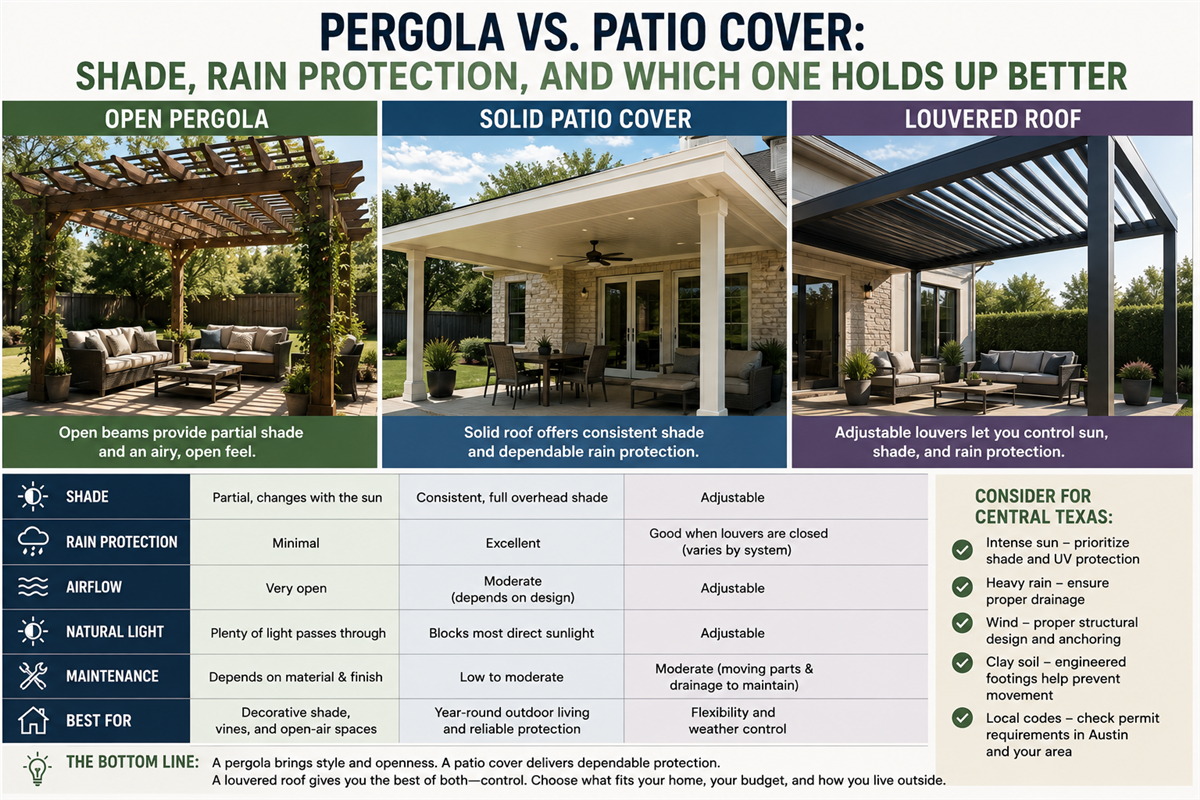
A traditional pergola filters sunlight but leaves the roof open to rain. A solid patio cover provides more consistent shade and overhead weather protection. A louvered roof offers another option: adjustable overhead slats that can open for sunlight and airflow or close to shed rain, depending on the system.
Each design has advantages, and each performs differently in Central Texas weather.
Before investing in an outdoor living project, it helps to understand how these structures compare in terms of shade, rain protection, durability, maintenance, and everyday use.
What's the Difference Between a Pergola and a Patio Cover?
The biggest difference is the roof.
A traditional pergola uses an open framework of beams or rafters. A solid patio cover has a continuous roof surface, while a louvered roof uses adjustable slats to control how much sunlight and airflow enter the space.
Although these structures can sometimes look similar, they don't necessarily provide the same protection.
| Feature | Open pergola | Solid patio cover | Louvered roof |
|---|---|---|---|
| Shade | Partial, changing with the sun | Consistent overhead shade | Adjustable |
| Rain protection | Minimal | Designed to shed rain | Depends on the system and whether louvers are closed |
| Airflow | Very open | Depends on roof height and side openings | Adjustable |
| Natural light | Plenty of light passes through | Blocks most direct sunlight underneath | Adjustable |
| Maintenance | Depends on material and finish | Depends on roof and framing materials | Includes moving parts and drainage components |
| Best use | Decorative shade and an open-air feel | A sheltered outdoor living area | Flexible shade and weather control |
These are general comparisons. Actual performance depends on the structure's design, materials, installation, orientation, and exposure.
1. Traditional Pergolas: Open, Airy, and Decorative
A traditional pergola is a good choice when you want to define an outdoor space without completely enclosing it beneath a roof.
The open beams create visual interest, and the gaps allow sunlight to move across the patio throughout the day. Some homeowners add climbing plants, shade fabric, or other features to increase coverage.
How well does a pergola block Texas sun?
That depends on the spacing and direction of the overhead beams, the time of day, and the orientation of the structure.
A pergola can provide welcome shade, but it usually won't block the sun as consistently as a solid patio cover. During Austin's hottest months, direct afternoon sunlight can still make a space uncomfortable, especially when the structure faces west or south.
If you plan to use the patio during the hottest part of the day, consider how the sun moves across your yard before settling on an open design.
Does a traditional pergola keep out rain?
No—not on its own.
Rain passes through an open pergola, even when the overhead beams provide some protection from direct sunlight. Outdoor furniture, cushions, electronics, and other items beneath it will still be exposed to weather.
A shade canopy or other roof addition may improve protection, but the level of coverage depends on the material and design. Don't assume a decorative canopy is equivalent to a properly designed, weather-shedding roof.
Which materials hold up best?
Wood pergolas offer a natural appearance and can complement many home styles. However, exposed wood requires appropriate finishing and periodic maintenance to manage weathering, moisture, and deterioration.
Aluminum structures can reduce some routine maintenance associated with painted or stained wood, although coatings, fasteners, connections, and other components still need attention.
The best material depends on the desired appearance, budget, exposure, and willingness to maintain the structure.
2. Solid Patio Covers: Consistent Shade and Better Rain Protection
If your main goal is to use your patio during sunny afternoons or light rain, a solid patio cover is often the more practical option.
A properly designed roof provides consistent overhead shade and directs rain away from the covered area. Depending on the design, it can also accommodate lighting, ceiling fans, and other features that make the patio feel more like an outdoor room.
Why solid coverage can make a difference in Austin
Central Texas summers bring strong sunlight and high temperatures. A solid roof blocks direct sunlight beneath it, which can make the space more comfortable than an uncovered patio or traditional open pergola.
An insulated aluminum patio cover can offer an additional benefit: the insulation helps limit heat transfer through the roof panels. That may make the covered space more comfortable than a non-insulated roof under similar conditions, although overall comfort still depends on airflow, sun exposure, and other factors.
Solid coverage also protects the patio surface and furnishings from direct rainfall. The structure still needs appropriate slope, flashing where applicable, gutters or drainage provisions, and a safe path for runoff.
Will a patio cover make the house darker?
It can.
A roof attached near the back of the home may reduce the natural light entering adjacent windows or doors. The effect depends on the roof's depth and height, the orientation of the house, and the location of nearby windows.
If your kitchen or living room relies on afternoon sunlight, consider how much light the proposed cover will block. A design that provides excellent patio shade could also change the brightness of the interior.
What about wood versus aluminum patio covers?
Wood-framed covers can be customized to complement the home's architecture and may be a good fit for homeowners who want a traditional appearance.
Aluminum patio covers offer another approach, including insulated roof panels and different finish options. Depending on the system, they may require less routine finish maintenance than exposed wood.
Neither material is automatically superior for every project. Structural design, roof construction, connections, drainage, installation quality, and maintenance all influence long-term performance.
3. Louvered Roofs: Adjustable Shade and Weather Control
A louvered roof sits between the open pergola and the solid patio cover in terms of flexibility.
Its overhead slats can open to allow more sunlight and airflow, angle to control shade, or close to provide overhead rain protection. Many systems are motorized, and some include rain sensors or integrated drainage channels.
For homeowners who want more control over changing weather conditions, this can be an appealing option.
How do louvered roofs handle rain?
When closed, a properly designed louvered system is intended to direct rain toward its drainage channels or gutters. However, not every louvered roof provides the same level of rain protection.
The details matter, including:
How the louvers overlap or seal when closed
How water travels through the frame and drainage channels
Whether gutters and downspouts can handle the expected runoff
How the system performs in wind-driven rain
Whether the installation follows the manufacturer's requirements
Even a well-designed system shouldn't be assumed to be completely leakproof under every weather condition. Ask the manufacturer or installer exactly what rain performance is specified for the model you're considering.
Are louvered roofs better in Texas heat?
They offer more flexibility, but they don't eliminate the heat.
Opening the louvers allows more airflow and sunlight. Closing or angling them can reduce direct sun exposure. That flexibility can be useful when conditions change throughout the day.
However, a louvered roof may cost more than a basic pergola or standard patio cover because of its moving components, controls, and drainage design. Motorized systems may also require electrical work and ongoing maintenance.
If you rarely adjust the roof or primarily want constant shade, a simpler solid cover may be a better fit for your needs.
Which Structure Holds Up Better in Central Texas Weather?
There isn't one winner in every category. Durability depends less on the name of the structure and more on how it is designed, constructed, installed, and maintained.
Austin-area outdoor structures must account for intense sunlight, temperature changes, heavy rain, and occasional severe storms. Wind exposure and soil conditions also matter.
Wind and storm performance
All three options need to be designed for the conditions at the property. A roof that catches wind can place substantial loads on its beams, posts, footings, and connections.
An open pergola allows air and rain to pass through its roof, but that doesn't automatically make it storm-proof. Solid patio covers and louvered roofs also require appropriate structural design and secure connections.
For motorized louvered systems, ask how the manufacturer recommends positioning the louvers during high winds. The answer can vary by product.
Rainwater drainage
A solid patio cover and a closed louvered roof need a planned path for water to leave the structure.
Poorly directed runoff can contribute to erosion, standing water, or drainage problems around the patio and foundation. Downspouts should discharge water in a suitable location rather than concentrating it beside the home or support footings.
Traditional open pergolas allow rain to fall through the roof, but the patio surface and surrounding landscape still need to handle that water.
Footings and soil movement
Central Texas has expansive clay soils in many areas. Soil movement can affect outdoor structures when footings, foundations, or connections are not appropriate for the site and loads.
A pergola isn't exempt from structural requirements just because its roof is open. Likewise, a lightweight-looking aluminum cover still needs adequate support and anchoring.
The appropriate footing design depends on the soil, structure, loads, and site conditions. For more on this issue, see our related article about why pergolas and patio covers need engineered footings in Austin clay.
Maintenance over time
Maintenance varies by material and system.
Wood pergolas: Inspect for deterioration, loose connections, and finish wear. Repainting or restaining may be needed.
Aluminum pergolas and covers: Check fasteners, finishes, and drainage components, and clean according to the manufacturer's instructions.
Louvered roofs: Keep drainage channels clear and inspect motors, controls, seals, and moving parts as recommended by the manufacturer.
No structure is maintenance-free. Routine inspections can help identify small problems before they become more expensive repairs.
Which Option Is Best for Your Backyard?
The right choice comes down to how you want to use the space.
Choose a traditional pergola if:
You want an open, architectural feature.
Filtered shade is enough for your needs.
You prefer an airy outdoor space with plenty of natural light.
You don't need dependable rain protection.
Choose a solid patio cover if:
You want consistent shade throughout the day.
You plan to use the space during light rain.
You want to protect outdoor furniture from direct sunlight and rainfall.
You prefer a simpler roof system without moving parts.
Choose a louvered roof if:
You want to adjust sunlight and airflow throughout the day.
You want rain protection when the louvers are closed.
You value flexibility and are comfortable with a more complex system.
Your budget allows for the added features and maintenance.
A fourth consideration is how the structure connects to the house. An attached cover can feel like an extension of the indoor living area, while a freestanding pergola may work better near a garden, pool, or separate seating area.
What About Cost?
Pricing varies widely based on the size of the structure, materials, roof type, foundation requirements, attachment details, electrical work, and site access.
A simple open pergola generally has fewer roof components than a motorized louvered system. A solid patio cover may fall between them, but a custom wood-framed cover, insulated aluminum system, or complex attached structure can change the comparison.
For a realistic estimate, compare proposals that include the same footprint and scope. Make sure each quote explains what is included for:
Structural posts, beams, and footings
Roof materials and insulation, if applicable
Attachment and flashing details
Gutters and downspouts
Electrical work, fans, lighting, or motorized controls
Permits, engineering, and finish work where required
A lower initial price isn't necessarily the better value if important structural or drainage work is excluded. Likewise, premium features aren't worth paying for if you won't use them.
Before construction, check the applicable local permitting requirements. The City of Austin provides a residential building permit guide, but requirements vary by jurisdiction and project scope.
Frequently Asked Questions
Does a pergola protect you from rain?
A traditional open pergola does not provide dependable rain protection. Water passes through the gaps in the roof. A solid cover or a suitable louvered system is a better choice when keeping the covered area dry is a priority.
Is a louvered roof waterproof?
Performance depends on the product, design, installation, drainage, and weather conditions. A closed louvered roof is designed to shed rain, but homeowners should confirm the manufacturer's stated limitations rather than assume every system is completely waterproof.
Is an insulated patio cover worth it in Texas?
It may be worthwhile if you want consistent shade and want to limit heat transfer through the roof panels. The benefit depends on the insulation system, sun exposure, airflow, and how you use the space.
Which structure requires the least maintenance?
Maintenance depends on the materials and features. An aluminum structure may avoid some of the painting or staining associated with wood, but a louvered roof adds moving components and drainage channels that need attention.
Can a pergola be attached to my house?
Some pergolas are designed to attach to a home, while others are freestanding. An attached structure requires appropriate connections and careful consideration of the home's exterior wall and water-management details. Whether a permit is required depends on the jurisdiction and project.
Which option is best for a west-facing patio?
A west-facing patio receives strong afternoon sunlight, so a traditional open pergola may not provide enough shade for comfortable summer use. A solid cover or adjustable louvered roof may be more suitable, depending on your preferences for shade, airflow, and natural light.
The Bottom Line
A pergola, solid patio cover, and louvered roof can all improve an outdoor space, but they solve different problems.
A traditional pergola emphasizes openness and filtered shade. A solid patio cover offers consistent overhead shade and rain protection. A louvered roof provides adjustable coverage, with performance that depends on the particular system.
For Central Texas homeowners, the best investment starts with how the patio will be used—not just how the structure looks. Consider the sun's direction, the need for rain protection, structural requirements, drainage, and long-term maintenance before choosing a design.
JP Exteriors helps homeowners plan outdoor living improvements that complement their homes and suit their needs. A well-planned structure should look right, function as intended, and be built with the details that support long-term performance.
Get Started With a Free Roofing Consultation
Planning a pergola or patio cover? JP Exteriors offers outdoor living solutions for homeowners in Austin and surrounding Central Texas communities. We can help you explore options for a shaded, functional space that fits your home and how you want to use it.
Remember: When you refer a friend or neighbor for windows, siding, roofing, or door replacement, you can earn up to $250 through the JP Exteriors Referral Program.
Subscribe to JP Exteriors's Blog


Comments