If you're replacing a roof in Austin, your roofer may eventually ask: "Do you want radiant-barrier decking?" The product may be called TechShield®, radiant-barrier sheathing, or reflective roof decking depending on the manufacturer. The idea sounds simple — put a reflective foil layer on the underside of the roof deck, reflect some of the sun's heat away from the attic, and make the air conditioner work less. But the question homeowners actually want answered is: how much will it really save me?
The honest answer is that it can help, but don't expect your electric bill to suddenly drop 30% just because you installed radiant-barrier decking. Radiant barriers address one specific part of your home's heat gain. Your home's insulation, ductwork, HVAC efficiency, air leakage, windows, roof color, attic ventilation, shade, and thermostat settings all affect the final bill too. In hot climates, the U.S. Department of Energy's Building America program reports that radiant barriers can reduce cooling costs by roughly 8% to 12%, while the DOE's general consumer guidance cites a slightly more conservative 5% to 10% range — and in both cases, the agency emphasizes that actual performance depends heavily on the specific home and installation. So let's look at the math.
What Is Radiant-Barrier Roof Decking?
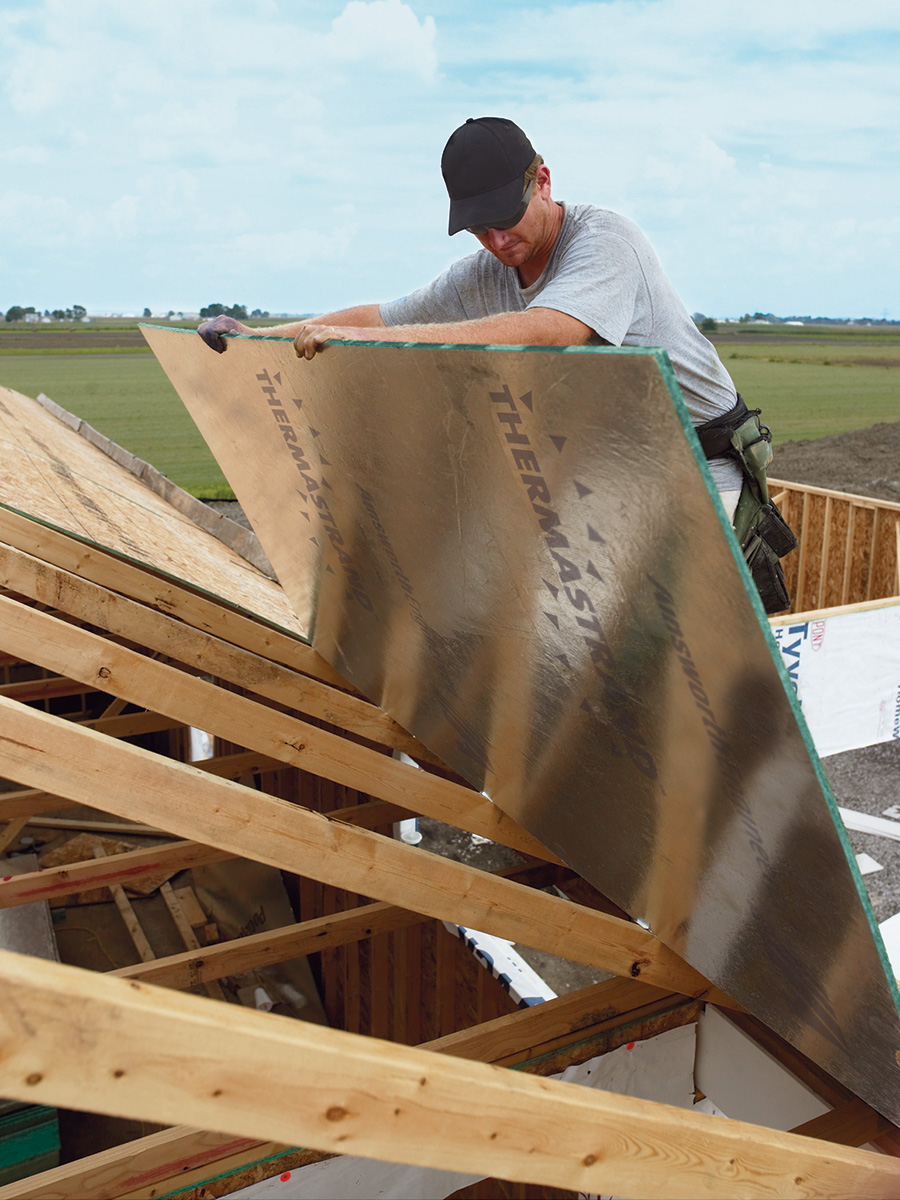
Standard roof decking is a structural layer, commonly OSB or plywood, installed over the roof framing. Radiant-barrier decking adds a highly reflective foil surface to the underside of that structural panel. Products like LP TechShield are designed to reflect radiant heat away from the attic rather than allowing as much of that heat to radiate downward into the attic space below.
The reflective surface needs to face an attic air space to actually function as a radiant barrier — APA guidance specifically notes that the foil side should face the attic, with an air space in front of it, for the reflective effect to work as intended. This is an important distinction: radiant-barrier decking is not conventional insulation. It doesn't work primarily by adding a thick layer of material with a high R-value — it reduces radiant heat transfer specifically. Think of it as another tool in the overall roof assembly, not a replacement for attic insulation.
Why Your Attic Gets So Hot in Austin
On a sunny summer day, your roof absorbs a tremendous amount of solar energy. That heat moves through the roof assembly in several ways — some is conducted through the roof materials directly, some is transferred through air movement, and some is transferred as thermal radiation. That last category is exactly where a radiant barrier comes into play.
The Department of Energy notes that roof surfaces in hot climates can exceed 150–160°F under strong sun, and that a radiant barrier reduces how much of that heat radiates down into the attic. Once the attic gets hotter, the cooling system has more work to do — especially when HVAC equipment or ductwork is actually located in the attic, which is common in a lot of Austin homes. That's exactly why radiant barriers tend to make more sense in hot, sunny climates than in mild or cold ones, where the DOE itself notes it's usually more cost-effective to add conventional insulation instead.
So Does TechShield Actually Lower the Cooling Bill?
Potentially, yes — but this is where marketing claims can get misleading. A manufacturer may tell you its foil surface reflects a very high percentage of radiant energy. Weyerhaeuser, for example, states that its radiant-barrier sheathing can reflect up to 97% of the sun's radiant energy, while also specifically noting that actual energy savings depend on factors like local utility rates, home size, and climate.
Those are two very different measurements. "Reflects 97% of radiant energy" does not mean "cuts your electric bill by 97%." The first is a property of the reflective surface under specified testing conditions. The second would be a whole-house energy claim, and your air conditioner isn't spending 100% of its electricity fighting heat that enters specifically through the roof — a meaningful share of your cooling load comes from walls, windows, air infiltration, appliances, occupants, and outdoor air temperature generally. Radiant heat through the roof deck is one contributor among several, which is exactly why the DOE's real-world figure of 5% to 12% in savings — not 97% — is the number that actually matters for your budget.
What Independent Research Actually Shows
Beyond the manufacturer's reflectivity claims, independent field studies give a clearer picture. A DOE and Oak Ridge National Laboratory field study of Florida homes — a climate reasonably close to Austin's — measured roughly 9% in cooling energy savings and a 16% reduction in peak cooling load after a radiant barrier retrofit. Peak load is worth paying attention to specifically, since that's the worst stretch of a hot August afternoon, when your AC system is running hardest and least efficiently — and it's often where radiant barriers show their clearest benefit, even when the whole-summer average savings look more modest.
It's also worth knowing that radiant barrier products don't carry an official R-value. The EPA has stated that radiant barrier products don't carry a meaningful R-value because the convective air movement in an open attic can't be reliably quantified the same way, and the FTC has stated there's no generally accepted test procedure for assigning one. R-value measures resistance to conducted heat; a radiant barrier addresses radiant heat specifically, which is a genuinely different mechanism. Any product advertising a specific R-value for foil sheathing is quoting a number that can't actually be measured in a standardized way — worth keeping in mind if you see that claim on a brochure.
Does It Matter Whether Your Ductwork Is in the Attic?
Significantly, yes. The DOE specifically notes that radiant barriers are more effective when cooling air ducts are located in the attic, since a radiant barrier reduces heat radiating onto those ducts directly, not just the general attic air. If your HVAC system and ductwork sit in the attic — which is common in a lot of Austin-area homes — a radiant barrier has more opportunity to make a measurable difference than in a home where the ductwork runs through conditioned space instead.
What Radiant Barriers Don't Do
This is worth being direct about. A radiant barrier doesn't replace attic insulation, doesn't seal air leaks, doesn't improve HVAC equipment efficiency, doesn't fix inadequate attic ventilation, and doesn't compensate for old or inefficient windows. If your attic is significantly under-insulated, your ductwork has major leaks, or your HVAC system is old and inefficient, those issues are likely costing you more on your cooling bill than a missing radiant barrier ever would. Building science guidance generally recommends addressing insulation and air sealing first, with a radiant barrier as an additional upgrade layered on top of a home that's already reasonably well insulated and sealed — not as a substitute for those fundamentals.
Does Dust Affect Performance Over Time?
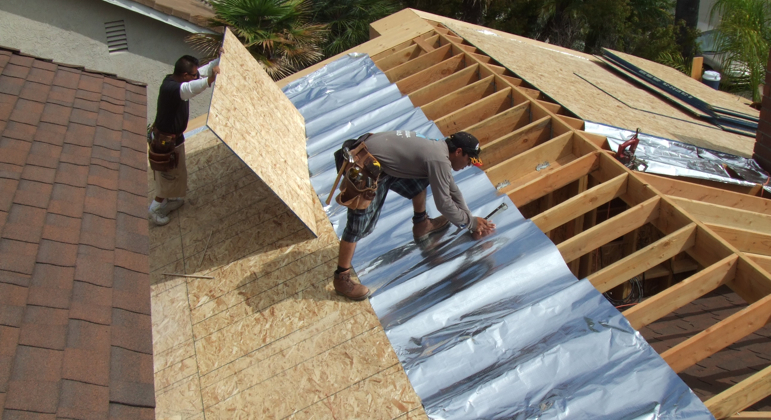
Yes, and this is a detail that's easy to overlook. Reflective foil loses effectiveness as dust accumulates on its surface, since dust reduces how much radiant energy actually gets reflected rather than absorbed. This is one reason installation orientation matters — a radiant barrier installed on the underside of the roof deck, facing down into the attic, tends to accumulate far less dust over time than one laid flat on the attic floor. Manufacturer and installation guidance generally favors attaching the barrier to the roof deck or rafters rather than laying it across the attic floor, partly for this reason.
Is Radiant Barrier Decking Worth It for a Reroof?
For most Austin homeowners already replacing their roof deck, radiant-barrier decking is worth serious consideration — the cost premium is typically modest when it's included as part of a full deck replacement, since you're already paying for the sheathing itself either way. The upgrade tends to make less sense as a standalone retrofit project on a roof that doesn't otherwise need deck replacement, since removing and reinstalling decking purely to add a radiant barrier adds meaningfully more cost and labor than including it during a project where the decking is being replaced anyway.
Questions to Ask Your Roofer About Radiant Barrier Decking
Before deciding, it's worth asking what specific product is being proposed and what its actual tested reflectivity is, how much the radiant-barrier upgrade adds to the total project cost, whether your HVAC ductwork is located in the attic, what your current attic insulation levels are, whether your attic ventilation is adequate for the home's design, and what realistic savings range applies to a home like yours rather than a generic percentage pulled from a brochure. A contractor who can walk through those specifics with you is giving you a much more useful answer than one who simply says "it'll lower your electric bill."
Frequently Asked Questions
How much will radiant barrier decking actually lower my electric bill?
Independent research generally shows cooling cost reductions in the range of 5% to 12% in hot climates, according to the Department of Energy — not the much higher reflectivity percentages sometimes advertised by manufacturers.
Is radiant barrier decking the same as insulation?
No. Radiant barriers reduce radiant heat transfer, while insulation reduces conducted heat transfer. They work through different mechanisms and aren't interchangeable — a radiant barrier supplements insulation rather than replacing it.
Does radiant barrier decking make the biggest difference if my ductwork is in the attic?
Yes. The Department of Energy specifically notes radiant barriers are more effective when cooling ductwork is located in an unconditioned attic, since the barrier reduces radiant heat reaching the ducts directly.
Can I add radiant barrier decking without replacing my whole roof?
It's possible as a standalone retrofit, but it's generally far more cost-effective to include it as part of a full deck replacement, since the decking is already being removed and reinstalled either way.
Does dust reduce how well radiant barrier decking works?
Yes. Dust accumulation on the reflective surface reduces its effectiveness over time, which is part of why installation orientation and location matter for long-term performance.
Do radiant barrier products have an R-value?
No official one. The EPA and FTC have both stated there's no generally accepted way to test and assign an R-value to radiant barrier products, since they work by reducing radiant heat transfer rather than conductive resistance.
Is radiant barrier decking worth it in a mild or cold climate?
Generally not as much. The Department of Energy notes that in cooler climates, it's usually more cost-effective to add conventional insulation instead of a radiant barrier.
Will radiant barrier decking fix a poorly insulated or poorly ventilated attic?
No. It addresses radiant heat transfer specifically and doesn't compensate for inadequate insulation, air sealing, or attic ventilation — those issues should generally be addressed as a priority alongside or before a radiant barrier upgrade.
How much more does radiant barrier decking cost compared to standard decking?
It varies by manufacturer and project, but the incremental cost during a full reroof is typically modest compared to the cost of retrofitting it separately later.
Should I choose radiant barrier decking based on the manufacturer's reflectivity percentage?
Not by itself. A high reflectivity percentage describes the material's performance under specific test conditions, not your actual whole-home energy savings, which depend on insulation, ductwork location, HVAC efficiency, and other factors specific to your house.
The Bottom Line
Radiant barrier decking isn't a miracle upgrade, but it isn't a gimmick either. In a hot climate like Austin's, particularly in homes with attic ductwork, it can meaningfully reduce cooling costs and peak-load stress on your AC system — realistically somewhere in the 5% to 12% range according to independent research, not the far higher numbers sometimes implied by reflectivity marketing. It works best as one part of a well-insulated, well-ventilated, properly sealed home, not as a standalone fix for a home with bigger underlying efficiency problems.
At JP Exteriors, we help Austin-area homeowners understand what radiant-barrier decking actually does, what it costs as part of a reroof, and whether it makes sense for their specific home and attic setup.
Get Started With a Free Roofing Consultation
Remember: When you refer a friend or neighbor for windows, siding, roofing, or door replacement, you can earn up to $250 through the JP Exteriors Referral Program.
Subscribe to JP Exteriors's Blog



Comments