Choosing a new exterior color scheme is one of the most noticeable decisions you'll make during a siding replacement or exterior remodeling project. The right combination can transform your home's curb appeal, complement its architectural style, and make the entire property feel more inviting.
But in Central Texas, color selection involves more than picking a shade you like.
Long summers, intense sunlight, and significant afternoon heat can affect how exterior colors look and how painted surfaces age. A color that looks perfect on a small sample inside a showroom may look completely different once it's covering an entire wall in direct sunlight.
Before committing to a new exterior color, it's worth considering how the Texas climate, your home's existing features, and the materials you're using will influence the finished result.
Here's what homeowners should know before choosing siding, trim, and accent colors.
1. Why Texas Sun Should Influence Your Color Choice
Sunlight affects both the appearance and temperature of exterior surfaces.
One important factor is solar absorption. Darker surfaces generally absorb more solar energy than lighter surfaces, which tend to reflect more of it. This can cause darker exterior materials to become hotter when exposed to direct sunlight.
For homeowners, this matters for two reasons:
Surface temperature: Darker siding and painted surfaces can become hotter under direct sun exposure.
Color retention: Ultraviolet radiation and weather exposure can gradually change the appearance of exterior coatings.
The U.S. Department of Housing and Urban Development explains how sunlight, heat, and ultraviolet radiation contribute to the deterioration of building materials over time.
This doesn't mean every Texas home needs to be white or beige. Dark colors can look excellent on the right house. However, the material, coating, color formulation, and amount of sun exposure should all be considered.
A dark charcoal exterior on a shaded home may experience different conditions than the same color on a home with large, exposed south- and west-facing walls.
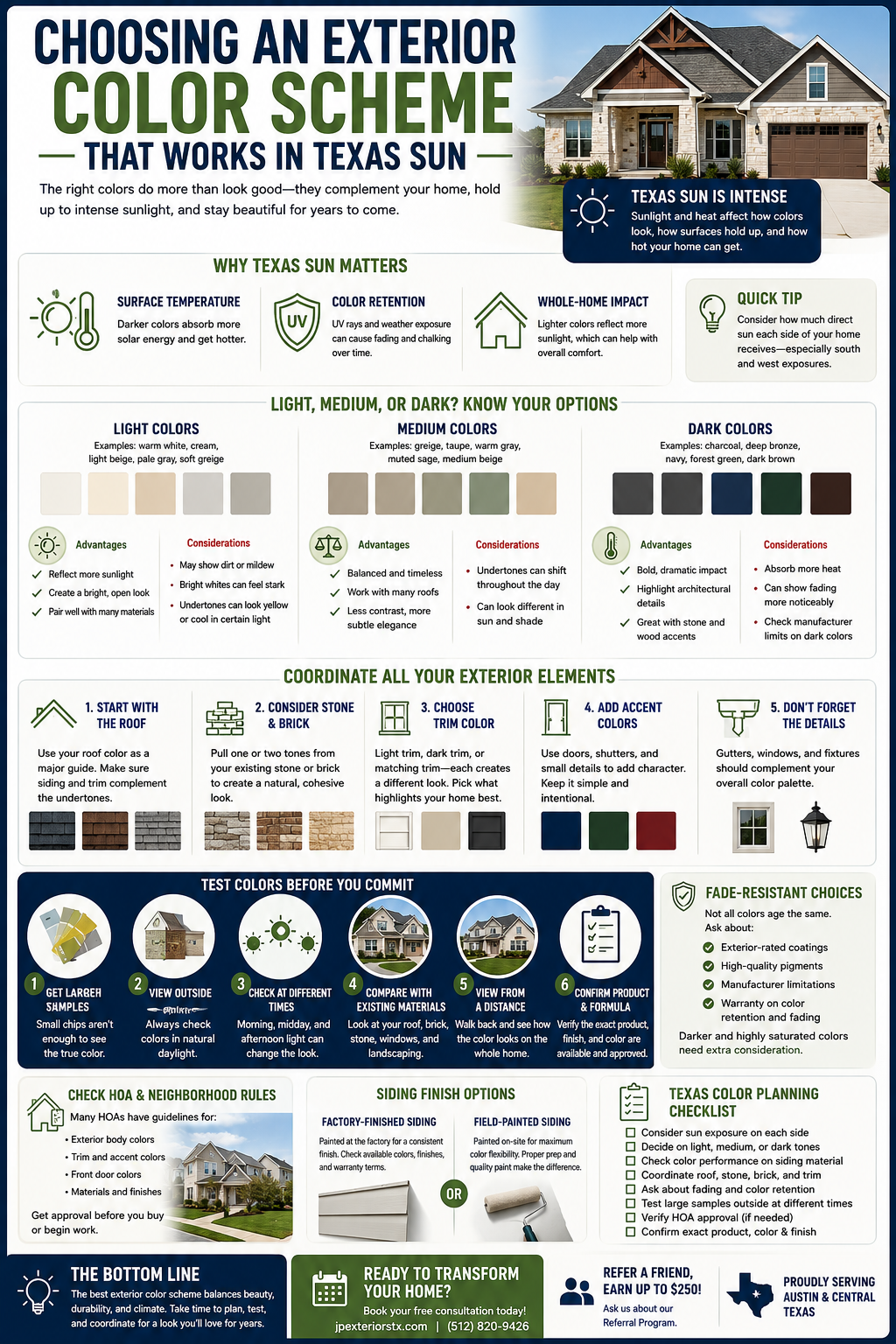
2. Light, Medium, or Dark? Understanding the Differences
There isn't one perfect exterior color for every Central Texas home. Each color range has advantages and considerations.
Light Colors: Classic and Reflective
<text>Examples: warm white, cream, light beige, pale gray, and soft greige.</text>
Light exterior colors are popular in Texas for good reason. They offer a clean appearance, work with many architectural styles, and generally absorb less solar energy than darker colors.
Advantages:
Reflect more sunlight than darker colors.
Create a bright, open appearance.
Pair well with stone, brick, and darker roofing.
Offer flexibility when selecting trim and accent colors.
Considerations:
Some light colors can show dirt, mildew, and environmental staining.
Bright whites may create a strong contrast in direct sunlight.
The wrong undertone can make a home look too cool, yellow, or washed out.
A warm white or soft cream can be a good choice when you want a lighter exterior without making the house look stark.
Medium Colors: A Balanced Option
<text>Examples: greige, taupe, warm gray, muted sage, and medium beige.</text>
Medium colors can provide a balance between the brightness of light neutrals and the visual weight of darker shades.
Advantages:
Work well with many roof and stone colors.
Can create a softer appearance than stark white.
Offer flexibility for contrasting trim and shutters.
Often provide a timeless look without feeling overly traditional.
Considerations:
Undertones can be difficult to judge from small samples.
Some grays may look blue or purple in certain lighting.
The same color can appear noticeably different on shaded and sunny elevations.
For homeowners who want something more distinctive than white but don't want a very dark exterior, medium neutrals are worth exploring.
Dark Colors: Bold and Modern
<text>Examples: charcoal, deep bronze, navy, forest green, and dark brown.</text>
Dark exteriors can give a home a dramatic, modern appearance. They can also create beautiful contrast with lighter trim, natural stone, and wood accents.
Advantages:
Create strong architectural contrast.
Highlight certain design features.
Work especially well with modern and contemporary styles.
Can complement lighter masonry and natural materials.
Considerations:
Dark surfaces generally absorb more solar energy.
Surface temperatures may become higher in direct sunlight.
Some dark colors may show fading or uneven color changes more noticeably.
Certain siding products and coatings have specific restrictions for darker colors.
If you're considering a deep color, check the siding manufacturer's requirements and the paint manufacturer's recommendations for that specific application. Some products have limitations on which colors can be used.
Dark colors are not automatically a bad choice for Texas homes. They simply deserve more attention during product and color selection.
3. South- and West-Facing Walls: The Areas That Deserve Extra Attention
Not every side of your home receives the same amount of sunlight.
In Central Texas, south- and west-facing elevations can experience substantial direct sun exposure. West-facing walls are particularly important to consider because they receive afternoon sunlight when outdoor temperatures are often high.
This can affect how exterior colors look and how coatings age.
For example, the same paint color may look relatively new on a shaded north-facing wall while showing more noticeable fading on a heavily exposed wall.
Sherwin-Williams identifies sunny exposures as a common factor in exterior paint fading. It also notes that chalking can make a coating appear lighter over time.
When choosing colors, consider:
Which walls receive direct afternoon sunlight?
Are there large, unshaded areas of siding?
Does the home have mature trees that provide shade?
Are certain walls exposed to reflected sunlight from nearby surfaces?
Will the selected coating and color be appropriate for the siding material?
A good color selection should account for the entire house rather than focusing only on the front elevation.
4. Which Exterior Colors Are More Likely to Fade?
All exterior coatings experience some degree of weathering over time. However, not every color ages in the same way.
The pigments used to create a color, the coating formulation, surface preparation, and environmental exposure can all affect color retention.
Sherwin-Williams explains that certain organic colors, including some blues and greens, can be more susceptible to fading than colors made with more durable inorganic pigments.
Bright, highly saturated colors can also require additional consideration.
This doesn't mean you should avoid every blue, green, or bold accent color. It means you should ask whether the specific color is suitable for exterior use and whether the selected coating is designed to maintain its appearance under strong sunlight.
Questions to Ask About Color Durability
Before choosing a color, ask your contractor or paint supplier:
Is this color approved for the siding material?
Is the coating designed for exterior exposure?
Does the manufacturer have any limitations on deep or highly saturated colors?
What does the product warranty say about fading and color retention?
Are there specific preparation or application requirements?
JP Exteriors uses Sherwin-Williams exterior paint for its exterior painting projects. The specific product and color should be selected based on the project conditions and manufacturer's recommendations.
For additional information, see Sherwin-Williams' guide to exterior paint fading.
5. How to Coordinate Siding, Trim, Roofing, and Stone
A successful exterior color scheme usually includes more than one color.
The siding, trim, roof, front door, gutters, windows, and masonry all contribute to the final appearance. Choosing each color independently can result in a combination that feels disconnected.
A practical approach is to start with the permanent features of your home.
Start With the Roof
Your roof is one of the largest visual elements of the exterior. If you're not replacing it, the siding and trim colors should complement the existing roofing material.
For example:
A dark gray roof can work with white, greige, sage, or light gray siding.
A brown or weathered wood-look roof can complement warm beige, cream, and earthy colors.
A black roof can provide contrast with lighter siding or support a more modern dark-and-light palette.
These are starting points, not strict rules. The undertones of the roof and siding matter just as much as whether the colors are light or dark.
Consider Existing Brick and Stone
If your home has brick or stone that will remain in place, use it as a major reference point.
Natural materials often contain several colors at once. A stone façade may include gray, tan, cream, and brown tones.
Look for one or two of those existing colors and use them to guide your siding and trim selections.
This helps the new exterior look intentional rather than making the original masonry feel like an unrelated feature.
Choose a Trim Color
Trim creates definition around windows, doors, rooflines, and architectural details.
Some common approaches include:
Light trim with medium or dark siding.
Matching trim and siding for a simpler appearance.
Dark trim to create contrast around lighter siding.
A subtle off-white or cream to soften a high-contrast color scheme.
The best option depends on the home's architecture and the other exterior materials.
Use Accent Colors Carefully
Front doors, shutters, porch ceilings, and other smaller details can introduce additional color without overwhelming the exterior.
A deep green, muted blue, or dark bronze front door can add character to a neutral home.
The goal is to create a coordinated palette rather than use too many competing colors.
6. How to Test Exterior Colors Before Making a Decision
One of the most common color-selection mistakes is choosing a shade based only on a small paint chip or a computer screen.
Colors can look very different depending on the lighting, surrounding materials, and size of the painted surface.
Before finalizing your selections, consider these steps:
1. Get larger samples.
Small color cards are useful for narrowing down options, but larger samples give you a better idea of how the color will look across a wall.
2. View samples outside.
Look at the colors in natural daylight rather than relying only on indoor lighting.
3. Check them at different times.
Compare the samples in the morning, around midday, and in the afternoon. Strong sunlight can change the way a color appears.
4. Compare them with existing materials.
Place samples near your roof, brick, stone, windows, and other permanent features.
5. Look at the color from a distance.
A color that looks attractive up close may feel too dark, bright, or bold when viewed across the entire exterior.
6. Confirm the exact product and color formula.
If you're using a manufacturer's prefinished siding option or a specific paint product, make sure the selected color is available and approved for that application.
Taking time to test colors can prevent an expensive decision you'll have to live with for years.
7. Don't Forget HOA Rules and Neighborhood Requirements
Before ordering siding or scheduling exterior painting, check whether your neighborhood has an architectural review process.
Some homeowners associations have restrictions on:
Approved exterior body colors.
Trim and accent color combinations.
Front door colors.
Changes to existing architectural features.
Visible exterior materials and finishes.
Even if a color looks appropriate for the neighborhood, it may not be on the approved list.
If your community requires approval, submit the proposed colors and materials before purchasing products or beginning work.
You should also check any applicable local requirements for your property. HOA approval and local building requirements are separate considerations.
8. What About ColorPlus and Field-Painted Fiber Cement?
For homeowners replacing older siding with James Hardie fiber cement, color selection may also involve deciding between factory-finished siding and field painting.
Both approaches have considerations.
Factory-Finished Siding
Factory-finished siding is painted before it arrives at the jobsite.
Depending on the product and color availability, this can provide a consistent factory-applied finish and reduce the need for field painting.
Homeowners should review the manufacturer's available colors, finish options, and warranty terms before choosing this route.
Field-Painted Siding
Field-painted siding is painted after installation.
This provides flexibility when selecting colors and allows homeowners to choose from a broader range of paint options.
JP Exteriors uses Sherwin-Williams exterior paint for its painting projects. Proper surface preparation, product selection, and application are important parts of the finished result.
The right choice depends on the homeowner's preferred appearance, budget, color selection, and project requirements.
9. A Simple Texas Exterior Color Planning Checklist
Before approving your exterior color scheme, review the following:
Consider how much direct sunlight each side of the home receives.
Decide whether you prefer a light, medium, or dark exterior.
Check how the color performs on the selected siding material.
Review the existing roof, brick, and stone colors.
Coordinate the siding, trim, and accent colors.
Ask about fading and color-retention information.
Test larger samples outside at different times of day.
Confirm HOA approval if required.
Verify the exact product, color, and finish before ordering.
A little planning can make the difference between a color scheme that looks good on a sample card and one that works beautifully on the finished home.
The Bottom Line: Choose a Color That Looks Good and Makes Sense for Your Home
Your home's exterior color should reflect your style, complement its architecture, and work with the materials protecting it.
In Central Texas, sunlight and heat deserve a place in that decision. Lighter colors generally absorb less solar energy than darker ones, while certain pigments and coatings may hold their color better under prolonged sun exposure.
But there is no single color that works for every home.
The best results come from considering the entire exterior: siding, trim, roofing, masonry, windows, and the amount of sunlight each elevation receives.
At JP Exteriors, we help homeowners throughout Austin and Central Texas with James Hardie siding replacement and exterior painting. Whether you're considering a complete exterior transformation or simply updating the look of your home, we can help you understand the available materials and options before moving forward.
Get Started With a Free Roofing Consultation
Thinking about updating your home's exterior? JP Exteriors can help you explore siding, paint, and other exterior remodeling options to create a coordinated look that fits your home.
Frequently Asked Questions
What are the best exterior house colors for Texas heat?
Lighter colors such as warm white, cream, beige, and light gray generally absorb less solar energy than darker colors. However, the best choice also depends on your home's architecture, roof color, surrounding materials, and personal preferences.
Do dark exterior colors fade faster in Texas?
Some dark and highly saturated colors may show fading more noticeably, but fading depends on the pigment, coating formulation, surface preparation, and sun exposure. Ask the paint or siding manufacturer about the specific color you're considering.
Which side of a house gets the most sun in Texas?
South- and west-facing walls can receive substantial direct sunlight. West-facing walls are especially important to consider because they receive afternoon sun during the hottest part of the day.
Should siding and trim be the same color?
Not necessarily. Matching colors can create a clean, understated appearance, while contrasting trim can highlight windows, doors, and architectural details. The best choice depends on the home's design and other exterior materials.
Can I use a dark color on James Hardie siding?
Some darker colors may be available, but homeowners should verify the selected color and finish with the siding manufacturer. Product-specific requirements and limitations may apply.
Should I choose my roof color before my siding color?
If you're keeping your existing roof, it's usually best to consider that color first because it is a large, permanent part of the exterior. If both the roof and siding are being replaced, coordinate the selections together.
Do I need HOA approval before changing my home's exterior color?
Some HOAs require approval before homeowners change siding, paint, trim, or other visible exterior features. Review your community's requirements and obtain any necessary approval before ordering materials or beginning work.
Remember: When you refer a friend or neighbor for windows, siding, roofing, or door replacement, you can earn up to $250 through the JP Exteriors Referral Program.
Subscribe to JP Exteriors's Blog



Comments