Replacing your home's windows is a significant investment, and choosing the right manufacturer can make the decision even more complicated.
Marvin, Andersen, and Pella are three well-known window brands, each offering multiple product lines, frame materials, glass packages, and customization options. But comparing them isn't as simple as looking at three prices and choosing the lowest one.
A basic vinyl window from one manufacturer is not necessarily comparable to a premium wood-clad or fiberglass window from another. Even within the same brand, the price can change considerably depending on the series, window size, operating style, glass package, and installation requirements.
For homeowners in Austin and Central Texas, the goal should be to find a window that fits the home's needs, performs well in the local climate, and makes sense for the project budget.
Here's how Marvin, Andersen, and Pella compare—and what you should understand before requesting a replacement window estimate.
1. How Much Do Marvin, Andersen, and Pella Windows Cost?
Window manufacturers generally do not publish one universal installed price. Most windows are configured and priced through dealers, distributors, or contractors.
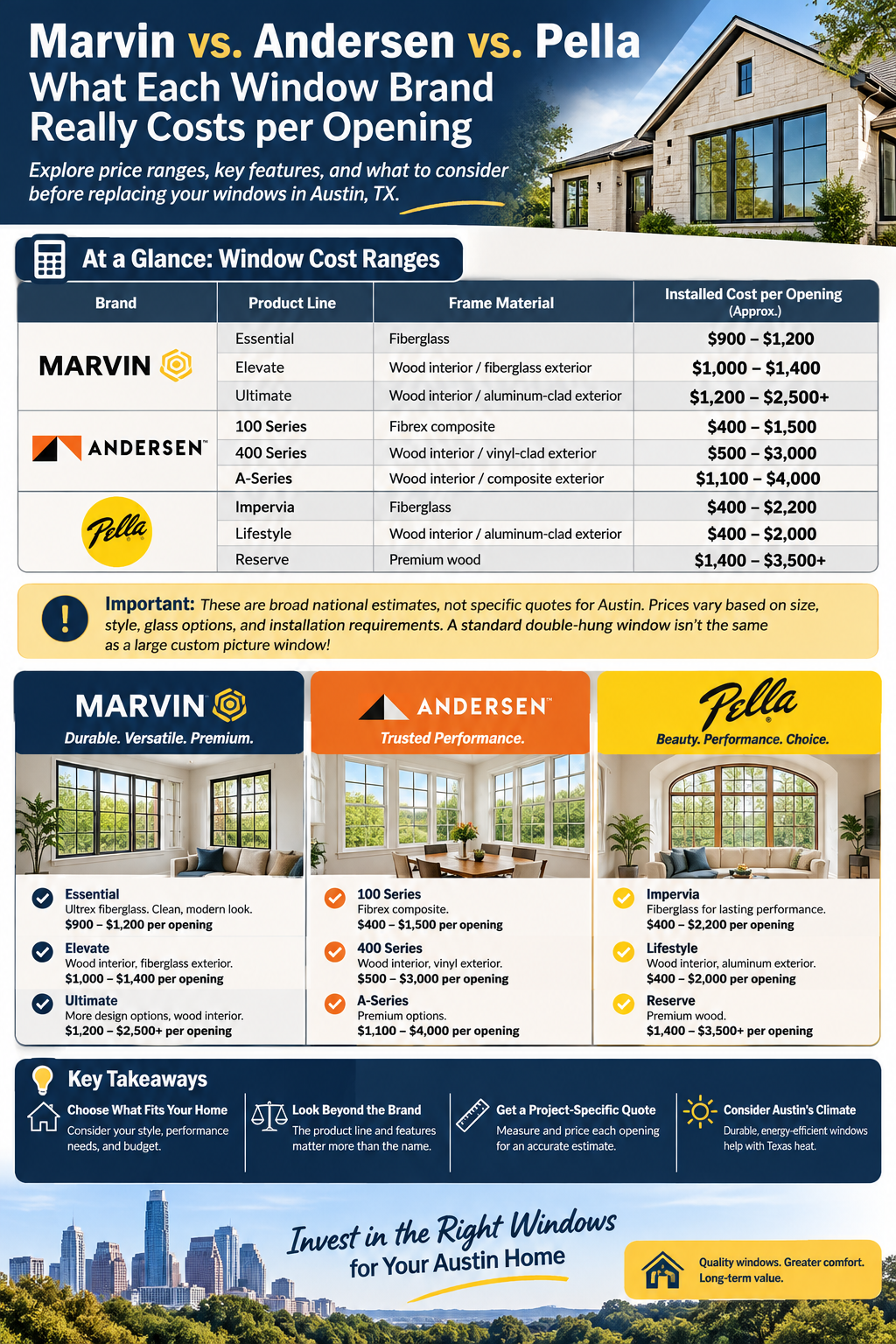
For preliminary budgeting, independent 2026 cost guides provide the following broad installed-price estimates for commonly selected product lines.
| Brand and product line | Frame material | Broad installed estimate per opening |
|---|---|---|
| Marvin Essential | Fiberglass | $900–$1,200 |
| Marvin Elevate | Wood interior / fiberglass exterior | $1,000–$1,400 |
| Marvin Ultimate | Wood interior / aluminum-clad exterior | $1,200–$2,500+ |
| Andersen 100 Series | Fibrex composite | $400–$1,500 |
| Andersen 400 Series | Wood interior / vinyl-clad exterior | $500–$3,000 |
| Andersen A-Series | Wood interior / composite exterior | $1,100–$4,000 |
| Pella Impervia | Fiberglass | $400–$2,200 |
| Pella Lifestyle | Wood interior / aluminum-clad exterior | $400–$2,000 |
| Pella Reserve | Premium wood | $1,400–$3,500+ |
Important pricing note: These are broad national reference ranges from independent cost guides, not JP Exteriors quotes or guaranteed Austin-area prices. The ranges cover different sizes, operating styles, configurations, and installation conditions. A standard double-hung window and a large custom picture window should not be expected to cost the same.
The estimates also demonstrate why comparing brand names alone can be misleading. The specific series and configuration matter more than the manufacturer's name.
For a project-specific estimate, each opening should be measured and priced according to the selected product and installation method.
2. Marvin Windows: Fiberglass and Premium Architectural Options
Marvin offers several window collections, ranging from streamlined fiberglass products to highly customizable wood and aluminum-clad options.
For homeowners who prefer to avoid vinyl-only products, Marvin's fiberglass collections are worth considering.
Marvin Essential
Material: Ultrex fiberglass inside and out.
Essential is one of Marvin's more streamlined product lines. It offers fiberglass construction with a simpler selection of styles and design options than some of the company's premium collections.
Potential advantages include:
Fiberglass construction.
Low-maintenance exterior and interior surfaces.
Clean, contemporary frame appearance.
A range of common window styles.
A practical option for homeowners seeking fiberglass without a fully custom product.
Preliminary budget: Approximately $900–$1,200 per opening for a typical Essential project based on published third-party estimates. Actual pricing depends on the window configuration and installation.
Marvin Elevate
Material: Natural wood interior with Ultrex fiberglass exterior.
Elevate combines the appearance of a wood interior with a fiberglass exterior.
This can appeal to homeowners who want a warmer interior finish while keeping the exterior relatively low maintenance.
Potential advantages include:
Wood interior appearance.
Fiberglass exterior.
More design flexibility than a streamlined fiberglass product.
A combination of traditional interior aesthetics and exterior durability.
Preliminary budget: Approximately $1,000–$1,400 per opening in one published 2026 installed-price estimate.
Marvin Ultimate
Material: Primarily wood interior with aluminum-clad exterior options, depending on configuration.
Ultimate is a premium collection designed for homeowners who want more architectural flexibility and customization.
Potential advantages include:
More extensive design options.
Wood interior finishes.
Multiple exterior finish choices.
Specialty shapes and configurations.
Options for more distinctive architectural projects.
Preliminary budget: Approximately $1,200–$2,500+ per opening in published third-party estimates. Custom sizes, specialty shapes, and premium configurations can cost more.
Who Should Consider Marvin?
Marvin may be worth exploring if you want fiberglass construction, a wood interior, or a premium architectural product with customization options.
The important decision is whether the added material and design features justify the difference in cost for your particular home.
Explore the collections at Marvin's official website.
3. Andersen Windows: Composite and Wood-Clad Options
Andersen offers a broad product lineup, including composite and wood-clad windows.
One of the manufacturer's best-known materials is Fibrex composite, used in its 100 Series.
Andersen 100 Series
Material: Fibrex composite inside and out.
The 100 Series is Andersen's more value-oriented composite product line.
Potential advantages include:
Fibrex composite construction.
Low-maintenance surfaces.
Contemporary frame profiles.
A range of common window styles.
A practical alternative for homeowners comparing composite products.
Preliminary budget: Approximately $400–$1,500 per opening in broad national installed estimates.
Andersen 400 Series
Material: Wood interior with a protective vinyl exterior, depending on the product.
The 400 Series is one of Andersen's best-known collections. It offers more configurations and options than the 100 Series.
Potential advantages include:
Wood interior appearance.
Protective exterior cladding.
A wide selection of window styles.
More interior and exterior design choices.
Options suited to traditional and transitional homes.
Preliminary budget: Approximately $500–$3,000 per opening in broad national installed estimates.
Andersen A-Series
Material: Wood interior with fiberglass and Fibrex composite exterior components, depending on the product.
The A-Series is designed for homeowners seeking a more architectural product with additional design flexibility.
Potential advantages include:
Wood interior finishes.
Composite and fiberglass exterior components.
More extensive customization.
Architectural styling options.
A broader range of design configurations.
Preliminary budget: Approximately $1,100–$4,000 per opening in broad national estimates.
Who Should Consider Andersen?
Andersen is worth considering if you want to compare composite construction, wood interiors, and a broad range of product configurations.
The 100 Series and 400 Series are not simply different price levels of the same window. Their materials and available features differ, so the right comparison depends on what you're trying to accomplish.
Review the options at Andersen's official window comparison page.
4. Pella Windows: Fiberglass, Vinyl, and Wood Options
Pella offers several product lines, including vinyl, fiberglass, and wood-based products.
For homeowners who want to compare alternatives to vinyl-only windows, Pella Impervia and its wood collections are particularly relevant.
Pella Impervia
Material: Duracast fiberglass.
Impervia is Pella's fiberglass product line. It is designed for homeowners who want a strong, low-maintenance frame material.
Potential advantages include:
Fiberglass frame construction.
Low-maintenance finish.
Multiple window styles.
Options for different glass packages.
A product line suited to homeowners comparing fiberglass alternatives.
Preliminary budget: Approximately $800–$1,800 per opening in one 2026 independent cost guide, although other guides report wider ranges.
Pella Lifestyle
Material: Wood interior with aluminum-clad exterior.
Lifestyle combines the appearance of natural wood inside with a protective exterior cladding.
Potential advantages include:
Natural wood interior.
Aluminum-clad exterior.
Multiple styles and configurations.
Options for upgraded glass packages.
A balance of traditional appearance and exterior protection.
Preliminary budget: Approximately $900–$2,000 per opening in one published 2026 estimate.
Pella Reserve
Material: Premium wood, with exterior finishes and configurations depending on the collection.
Reserve is a premium option for homeowners who want more architectural detail and customization.
Potential advantages include:
Premium wood construction.
Traditional and contemporary design options.
Custom configurations.
Extensive finish and design choices.
Preliminary budget: Approximately $1,500–$4,000+ per opening in broad national estimates.
Who Should Consider Pella?
Pella offers a wide range of product choices, which can make it useful when comparing different materials and budgets.
A homeowner who wants fiberglass may look at Impervia, while someone who prefers a wood interior may compare Lifestyle or Reserve.
Explore the available collections at Pella's official website.
5. What Actually Makes One Window More Expensive Than Another?
The manufacturer is only one part of the pricing equation.
Two windows from the same brand can have very different prices depending on their size, glass, operating style, and installation requirements.
Here are some of the biggest cost factors.
Frame Material
The frame material affects the product's construction, appearance, maintenance requirements, and price.
| Material | General characteristics |
|---|---|
| Vinyl | Often a more budget-friendly option with low maintenance |
| Fiberglass | Stable, durable frame material with a range of finish options |
| Composite | Combines materials to create a low-maintenance frame |
| Wood-clad | Wood interior with a protective exterior covering |
| Premium wood | More design and finish flexibility, often at a higher price |
No single material is automatically the best choice for every home. The right option depends on appearance, performance goals, budget, and maintenance preferences.
Glass Packages
The glass can have a significant effect on the total price.
Homeowners in Central Texas should pay particular attention to Low-E glass options and solar heat gain.
A window's glass package can include:
Double-pane insulated glass.
Low-E coatings.
Argon gas between panes.
Different solar-control options.
Specialty glass for specific applications.
Triple-pane glass where available and appropriate.
For Austin homes, selecting glass based on the home's exposure and cooling needs can be just as important as selecting the frame.
A window with a more expensive frame does not automatically have the best glass package for your home.
Window Style
A standard double-hung window generally has a different price than a large picture window, casement, bay, or specialty-shaped unit.
More complicated configurations may require:
Additional glass.
Larger or reinforced frames.
Multiple operating sections.
Custom manufacturing.
Additional installation labor.
The dimensions and design of each opening should be part of the estimate.
Color and Customization
Standard colors and configurations may be less expensive than custom finishes, specialty hardware, or unusual shapes.
If you're considering black frames, custom exterior colors, wood interior finishes, or special grille patterns, ask how those selections affect the price.
Installation Method
The installation method can also change the cost.
An insert or pocket replacement may be possible when the existing frame is suitable for reuse.
A full-frame replacement involves removing more of the existing window assembly and may require additional work around the opening.
The appropriate method depends on the condition of the existing window, the surrounding materials, and the goals of the project.
6. What Does a Whole-Home Window Replacement Cost?
Per-window pricing is useful for comparing products, but most homeowners are ultimately trying to understand the cost of replacing every window in the house.
The total depends on the number of openings, product series, sizes, glass packages, and installation scope.
For illustration, consider a project with 15 standard replacement openings.
| Average installed cost per opening | Approximate 15-window total |
|---|---|
| $900 | $13,500 |
| $1,200 | $18,000 |
| $1,500 | $22,500 |
| $2,000 | $30,000 |
| $2,500 | $37,500 |
These examples are simple budgeting calculations, not brand-specific quotes. A real project may include different window styles and sizes, and some large or specialty openings may cost considerably more.
For a more accurate comparison, request pricing for the exact same openings from each manufacturer.
What About a 20- or 25-Window Home?
The same principle applies to larger projects.
A 20-window project at an average of $1,200 per opening would have an illustrative total of $24,000. At $2,000 per opening, the same number of openings would total $40,000.
This is why choosing a product line before measuring the home can be misleading. The actual window schedule is what makes the comparison meaningful.
7. Why the Window Price Is Not the Same as the Installed Price
A window advertised online or displayed in a showroom may be priced as a product only.
That price does not necessarily include the work required to remove the old window and install the new one.
A complete replacement proposal may include:
Measuring and ordering the windows.
Removing existing units.
Preparing the openings.
Installing and securing the new windows.
Insulating and sealing appropriate gaps.
Flashing and water-management details.
Exterior trim and finishing.
Interior finishing, if included in the scope.
Disposal of removed materials.
Cleanup.
The exact scope depends on the installation method and the contractor's proposal.
When comparing estimates, make sure you understand whether each price includes product only, installation, or a complete replacement.
8. What Should Austin Homeowners Look for in a Window?
Central Texas homes experience long periods of heat and strong sunlight. Window selection should account for more than appearance.
Consider these factors when comparing products.
Solar Heat Gain
Solar heat gain is especially important in a cooling-dominated climate.
The Solar Heat Gain Coefficient, or SHGC, measures how much solar radiation enters through the window.
A lower SHGC generally means less solar heat enters the home through the glass. However, the appropriate value depends on the home's orientation, shading, daylight goals, and energy-performance requirements.
U-Factor
U-factor measures how readily heat transfers through the entire window assembly.
A lower U-factor indicates better insulation performance.
Both U-factor and SHGC should be considered when comparing window specifications.
Air Leakage
A properly installed window should help limit unwanted air movement around the unit.
The product's air-leakage rating and the quality of installation both matter.
Installation Quality
Even a high-end window can perform poorly if it is installed incorrectly.
Proper measurements, fastening, insulation, flashing, and sealing are important parts of a successful replacement.
For additional information, homeowners can review the ENERGY STAR guide to window selection.
9. How to Compare Three Window Brands Fairly
If you're collecting estimates from Marvin, Andersen, and Pella, use the same information for each proposal.
Ask each contractor to quote:
The same number of openings.
The same approximate dimensions.
Comparable window styles.
Similar frame materials.
Comparable Low-E glass and solar-control options.
Similar color and finish selections.
The same installation scope.
Comparable trim and finishing work.
Then compare the written proposals side by side.
A quote for a Marvin fiberglass window should not automatically be compared with a Pella premium wood window or an Andersen entry-level composite window.
The materials, features, and intended applications are different.
The goal is to compare products that meet the same needs—not simply the lowest number on the page.
10. Which Brand Is the Best Value?
There isn't one winner for every homeowner.
Each manufacturer offers products at different price levels, and the best value depends on which features matter most to you.
Marvin may be worth considering if:
You prefer fiberglass construction.
You want a wood interior with a durable exterior.
You need more architectural customization.
You are comparing premium window options.
Andersen may be worth considering if:
You want to compare Fibrex composite windows.
You prefer wood interiors with protective exterior cladding.
You want a broad range of styles and configurations.
You need options at different price levels.
Pella may be worth considering if:
You want to compare fiberglass and wood options.
You prefer a broad product lineup.
You want choices between standard and premium collections.
You are comparing different glass and finish packages.
The best decision comes from matching the product to the home, not choosing a brand based on reputation alone.
The Bottom Line: Compare the Window, the Glass, and the Installation
Marvin, Andersen, and Pella all offer window products worth considering, but their collections are not interchangeable.
The frame material, glass package, window style, customization, and installation scope all affect the final price.
For homeowners in Austin and Central Texas, the smartest approach is to compare complete proposals for the same openings and similar performance goals.
At JP Exteriors, we help homeowners evaluate replacement window options from manufacturers including Marvin, Andersen, Pella, and others. We can review your existing windows, discuss product choices, and provide a proposal based on your home's actual openings and project requirements.
Get Started With a Free Roofing Consultation
Thinking about replacing your home's windows? JP Exteriors can help you compare product options, understand installation requirements, and plan a window replacement project that fits your home and budget.
Frequently Asked Questions
Are Marvin windows more expensive than Andersen or Pella?
They can be, particularly when comparing premium Marvin collections with entry-level products from other manufacturers. However, pricing depends on the exact series, material, size, glass package, and installation scope.
How much does a Marvin window cost installed?
Published third-party estimates vary by collection. A typical Marvin Essential project may fall around $900–$1,200 per opening, while premium Ultimate configurations can cost considerably more. These are general estimates, not local quotes.
How much does an Andersen 400 Series window cost?
Broad national estimates place Andersen 400 Series installed pricing at approximately $500–$3,000 per opening. The wide range reflects differences in size, style, configuration, and installation.
How much does a Pella Impervia window cost?
Published estimates vary. One 2026 cost guide places typical Impervia installations around $800–$1,800 per opening, while other guides report wider ranges. A written quote is needed for an accurate project price.
What is the best window material for Texas heat?
Fiberglass, composite, vinyl, and wood-clad windows can all be appropriate depending on the product specifications and installation. For Texas homes, compare the glass package, SHGC, U-factor, frame design, and air leakage rather than choosing based on material alone.
How much does it cost to replace 15 windows?
Using illustrative installed averages of $900–$2,500 per opening, a 15-window project could range from approximately $13,500 to $37,500. Actual pricing depends on the products, opening sizes, installation method, and finishing work.
Does window replacement include new trim?
It depends on the installation method and proposal. Some replacement projects retain existing trim, while others include new exterior or interior trim. Confirm exactly what is included before signing.
Does JP Exteriors install Marvin, Andersen, and Pella windows?
JP Exteriors works with window brands including Marvin, Andersen, and Pella, along with other manufacturers. Available products and configurations depend on the project and current product offerings.
Remember: When you refer a friend or neighbor for windows, siding, roofing, or door replacement, you can earn up to $250 through the JP Exteriors Referral Program.
Subscribe to JP Exteriors's Blog

Comments