A new deck can turn an ordinary backyard into a place to relax, entertain, and spend more time outside. But before choosing a decking material or sketching out the layout, most homeowners have one important question: How much will it cost?
The answer depends on more than the boards you see on the finished deck. The framing underneath, foundation and footings, railing, stairs, access to the yard, and overall design can all affect the final price.
Material selection is another major factor. Pressure-treated pine generally has a lower upfront cost, while composite products from Trex and TimberTech typically cost more initially but require less routine maintenance.
For Austin and Central Texas homeowners, here's how to compare the options and build a realistic deck budget.
1. How Much Does a Deck Cost in Austin?
Installed deck prices vary considerably based on the contractor, design, material grade, and project scope. Published Austin-area estimates show a wide range, particularly for composite decking.
For preliminary planning, the following broad ranges provide a starting point:
Decking material | Approximate installed planning range |
|---|---|
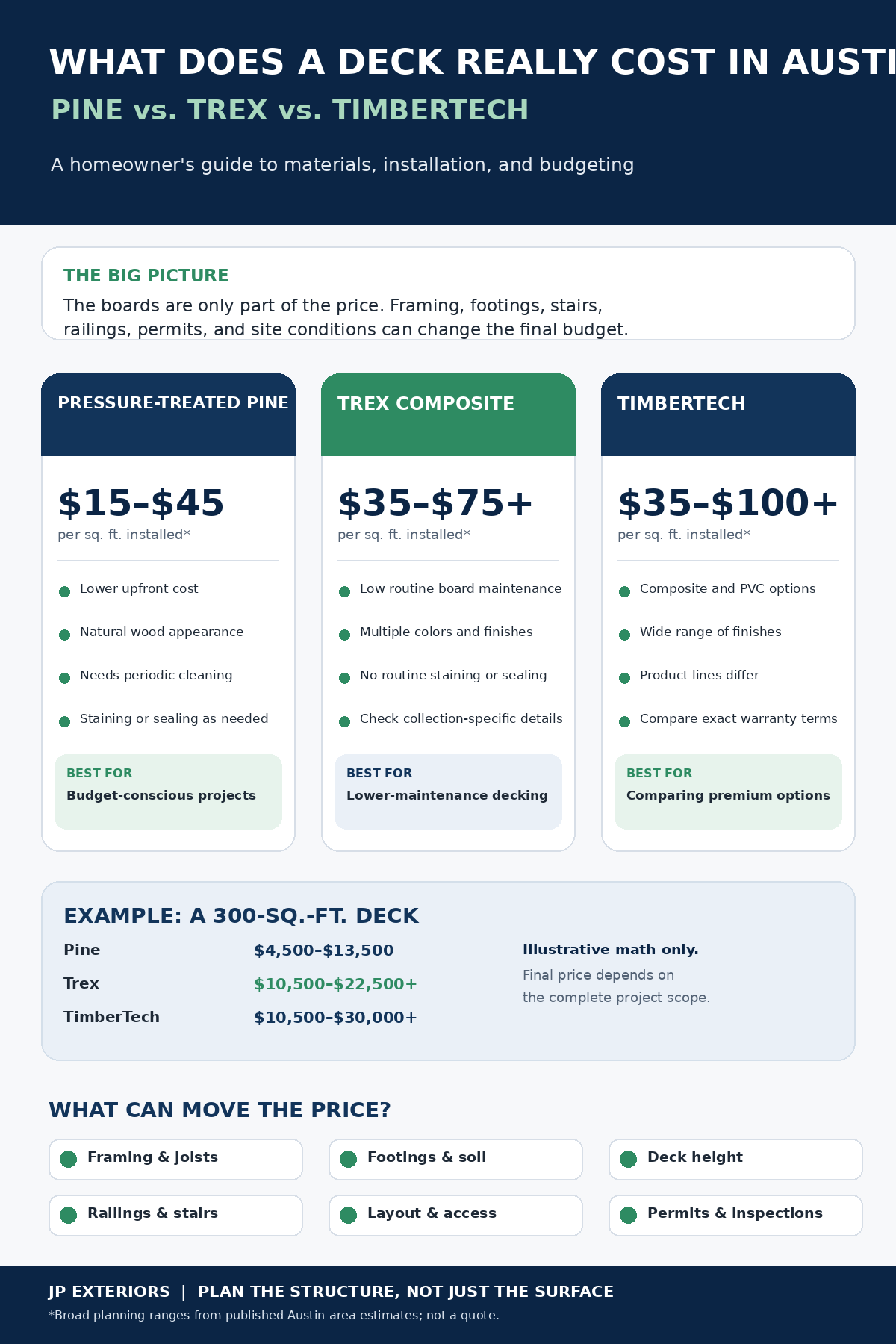
Pressure-treated pine | $15–$45 per sq. ft. |
Trex composite | $35–$75+ per sq. ft. |
TimberTech composite or PVC | $35–$100+ per sq. ft. |
These are broad budgeting ranges, not fixed prices or JP Exteriors quotes. Some published estimates include basic framing and railing, while others use different assumptions about the project. Premium product lines, elevated decks, complicated layouts, and extensive stairs or railings can push costs higher.
For reference, JP Exteriors uses approximately $65 per square foot as a preliminary planning figure for Trex deck projects. The actual proposal depends on the selected product and complete project scope.
What Could a 300-Square-Foot Deck Cost?
A 300-square-foot deck is a useful example for comparing material budgets.
Using the broad planning ranges above:
Material | Illustrative 300 sq. ft. budget |
|---|---|
Pressure-treated pine | $4,500–$13,500 |
Trex composite | $10,500–$22,500+ |
TimberTech composite or PVC | $10,500–$30,000+ |
These figures are mathematical examples based on the per-square-foot ranges. They are not interchangeable turnkey quotes. Before comparing estimates, confirm whether framing, footings, railing, stairs, demolition, permits, and cleanup are included.
2. Pressure-Treated Pine: The Lower Upfront-Cost Option
Pressure-treated pine is a common choice for homeowners who want a traditional wood deck without the higher initial cost of composite materials.
The lumber is treated to help protect it against decay and insect damage. It can be stained or painted to achieve a particular appearance, and damaged individual boards can often be replaced without changing the entire surface.
Potential advantages:
Generally lower upfront material cost.
Traditional natural wood appearance.
Can be stained or painted.
Individual boards can be replaced.
Familiar material for many deck builders.
Things to consider:
Requires periodic cleaning and maintenance.
Usually needs staining or sealing to maintain its appearance and help protect the surface.
Can develop splinters, cracks, checks, or surface discoloration.
Boards may warp, cup, or move as moisture conditions change.
Maintenance requirements can add time and expense over the years.
Is Pine a Good Choice for Austin?
It can be, particularly when upfront budget is the priority and the homeowner is comfortable maintaining the deck.
Central Texas weather brings intense sunlight, heat, and periods of heavy rain followed by dry conditions. Wood decking is exposed to those conditions every day.
A good maintenance routine can help preserve the appearance and condition of a pine deck, but homeowners should understand that wood is not a maintenance-free material.
Pine may be a sensible option for a simple, ground-level deck where keeping the initial investment lower is more important than minimizing future upkeep.
3. Trex Composite Decking: A Balance of Appearance and Maintenance
Trex is one of the best-known composite decking brands. Its products are made using a blend of reclaimed wood fibers and recycled plastic, with product construction and features varying by collection.
<text> </text>
Trex offers several product lines at different price and feature levels. The appearance, color selection, surface texture, and warranty terms depend on the collection.
Potential advantages:
No routine staining or sealing.
Available in a range of colors and wood-inspired finishes.
Resistant to many common issues associated with traditional wood decking.
Concealed fastening options are available for certain products.
Manufacturer warranty coverage varies by product line.
Things to consider:
Higher initial cost than many pressure-treated pine options.
The surface can become hot in direct Texas sunlight.
Scratches, dirt, and stains still require appropriate care.
The supporting frame must meet the product's installation requirements.
Color, texture, and warranty coverage differ between collections.
Which Trex Product Should You Consider?
Trex collections are not all identical.
More budget-oriented products may have a simpler color and finish selection, while premium lines offer additional surface textures, colors, and design features.
When comparing products, look beyond the brand name. Ask which collection is being quoted and review the specific warranty and installation instructions.
For Austin homeowners, it is also worth considering how much direct sun the deck receives. Darker boards and exposed surfaces can become uncomfortable underfoot during hot weather. If possible, review samples outdoors in the location where the deck will be built.
Learn more at Trex's official website.
4. TimberTech: Composite and Advanced PVC Options
TimberTech offers both composite decking and Advanced PVC decking. Although homeowners sometimes group them together, they are different product categories.
Composite products combine wood-based material and polymers. Advanced PVC decking uses a different construction, with no wood fibers in the board.
The exact characteristics, maintenance guidance, and warranty coverage depend on the specific collection.
Potential advantages:
Multiple product categories and price levels.
A wide selection of colors and finishes.
Options that resemble natural wood.
Low-maintenance alternatives to traditional wood decking.
Product-specific warranty coverage.
Things to consider:
Premium collections can have a higher initial cost.
Composite and PVC products should not be treated as interchangeable.
Surface temperature depends on color, sun exposure, and product design.
Installation details and framing requirements vary by collection.
TimberTech Composite vs. Advanced PVC
TimberTech composite products may appeal to homeowners looking for a traditional composite decking option.
Advanced PVC may be worth comparing when the homeowner wants a fully synthetic decking board and is comfortable with the higher cost that some premium products can involve.
Neither category automatically makes a better deck. The right selection depends on the desired appearance, budget, installation conditions, and product specifications.
Explore the options at TimberTech's official website.
5. What Makes a Deck More Expensive Than the Boards?
The decking material is only one part of the project. In many cases, the structure underneath and the features around the deck can have just as much influence on the final price.
Here are the major factors homeowners should consider.
Framing and Joists
The deck boards are attached to a supporting structure made up of joists, beams, posts, and other framing components.
The framing must be designed for the deck's dimensions, height, loads, and selected decking material.
Composite decking does not eliminate the need for a properly built structure. In fact, the manufacturer's installation requirements may specify joist spacing, fastening methods, ventilation, and other details that differ from a typical wood deck.
Footings and Soil Conditions
Deck footings transfer the structure's weight into the ground.
Their size, depth, spacing, and design depend on the structure, soil conditions, loads, and applicable building requirements.
Central Texas soil conditions deserve particular attention. Expansive clay can shrink and swell as moisture levels change, which makes appropriate foundation planning important.
A contractor should evaluate the site and design the support system for the actual deck rather than assuming every backyard needs the same footing layout.
Deck Height
A low, ground-level deck is generally simpler than an elevated deck.
As the deck gets higher, the structure may require taller posts, additional bracing, more substantial connections, and protective railings.
Access to the underside can also become more complicated.
Railings
Railings can make a noticeable difference in the budget, especially when the deck has a long perimeter.
Options may include:
Pressure-treated wood railing.
Composite railing.
Metal or aluminum railing.
Cable railing.
Decorative railing systems.
The material, height, design, and installation requirements all affect the cost.
Stairs
A deck with several steps or a full staircase will generally cost more than one with a simple step down to the yard.
Stair width, number of risers, landings, handrails, and connections to the deck structure all need to be considered.
Deck Shape and Layout
A basic rectangular deck is usually easier to build than one with multiple levels, angled corners, curved features, or built-in seating.
Custom patterns can also increase material waste and installation time. For composite decking, angled board layouts may require closer joist spacing under the manufacturer's instructions.
6. Do You Need a Permit to Build a Deck in Austin?
Permit requirements depend on the location and design of the project.
The City of Austin provides specific exceptions for certain small, detached, low decks. For example, a deck that is under 200 square feet, not attached to the dwelling, and less than 30 inches above grade may qualify for a building-permit exemption, provided it is not in a flood hazard area.
However, an exemption from a permit application does not mean the project is exempt from applicable building codes or other requirements.
Attached decks, elevated structures, larger projects, and decks in regulated areas may require additional review.
If your home is outside Austin city limits, the applicable municipality or county may have different requirements.
Before construction begins, confirm the requirements for the property's actual jurisdiction. Do not assume that a neighbor's deck or a previous project establishes what is allowed on your property.
For official information, visit Austin Development Services.
7. Why the Installation Details Matter
A deck can look beautiful when it is finished, but the quality of the structure underneath is what helps it perform over time.
A complete deck proposal should address more than the surface boards.
Important details include:
Proper footing and post support.
Correct beam and joist sizing.
Appropriate connections and hardware.
Proper ledger attachment when the deck connects to the house.
Flashing and water management at the house connection.
Manufacturer-approved fasteners.
Required joist spacing for the selected decking.
Safe stairs, guards, and handrails where required.
The ledger connection deserves special attention. If a deck attaches to the home, that connection must be designed and installed correctly to help prevent water intrusion and structural problems.
Homeowners should also ask whether the existing exterior wall and attachment area are suitable for the proposed design.
8. How Much Maintenance Should You Expect?
One of the biggest differences between wood and composite decking is the maintenance routine.
Pressure-Treated Pine
Wood decking generally requires more ongoing attention.
Depending on exposure and product recommendations, maintenance may include:
Periodic cleaning.
Checking for loose or damaged boards.
Inspecting fasteners and connections.
Staining or sealing when appropriate.
Replacing boards that deteriorate.
The frequency depends on sunlight, drainage, weather exposure, and the finish used.
Trex and TimberTech
Composite and PVC decking generally do not require routine staining or sealing.
That does not mean they never need maintenance.
Homeowners should still expect to clean the surface, remove debris, and follow the manufacturer's care instructions. Railings, framing, fasteners, and other structural components also need periodic inspection.
The key difference is that the decking boards themselves generally require less recurring finish maintenance than traditional wood.
9. Which Decking Material Offers the Best Value?
The best value depends on how you use your deck, how long you expect to own the home, and how much maintenance you are willing to handle.
Pressure-treated pine may be the better fit if:
Your initial budget is the biggest priority.
You prefer the look of natural wood.
You are comfortable with periodic staining or sealing.
You want a straightforward deck design.
Trex may be the better fit if:
You want a lower-maintenance decking surface.
You prefer a wide selection of composite colors and finishes.
You want to compare several product tiers.
You plan to use the deck regularly and want to reduce routine board maintenance.
TimberTech may be the better fit if:
You want to compare composite and PVC options.
You are interested in premium surface finishes.
You want additional product choices and design flexibility.
You are comfortable evaluating the price differences between collections.
The lowest upfront price does not always mean the lowest long-term cost. On the other hand, a premium product is not automatically worth the additional investment for every homeowner.
The right comparison should consider the complete project price, expected maintenance, product warranty, and the way the deck will be used.
10. What to Ask Before Hiring a Deck Contractor
Before signing a contract, ask your contractor:
What decking brand, collection, and color are included?
What framing material and structural design will be used?
Are footings and excavation included in the price?
Does the proposal include railings, stairs, and handrails?
Are permits and inspections included, if required?
How will the deck connect to the house?
What flashing and water-management details are included?
What product and workmanship warranties apply?
How will additional work or unexpected site conditions be handled?
What is the expected construction schedule?
A detailed written proposal should identify the materials, scope, and important exclusions. That makes it easier to compare contractors and understand what you are actually purchasing.
The Bottom Line: Choose the Deck That Fits Your Budget and Your Lifestyle
Pressure-treated pine, Trex, and TimberTech can all be appropriate choices for a new deck, but they serve different priorities.
Pine generally offers a lower starting price, while composite and PVC products offer lower-maintenance decking surfaces at a higher initial investment.
For Austin homeowners, the material is only part of the decision. Proper framing, footings, drainage, flashing, stairs, and railings all contribute to a safe and successful project.
At JP Exteriors, we build Trex decks and help homeowners plan outdoor living improvements throughout Austin and Central Texas. We can discuss decking options, review your backyard layout, and provide a proposal based on the actual design and installation requirements.
Get Started With a Free Roofing Consultation
Thinking about adding a new deck or updating your outdoor living space? JP Exteriors can help you explore Trex decking options, discuss the project layout, and plan an outdoor space that works for your home.
Frequently Asked Questions
How much does a deck cost per square foot in Austin?
Published Austin-area estimates vary considerably. For preliminary planning, pressure-treated pine may range from approximately $15–$45 per square foot installed, while composite products can range from approximately $35–$100 or more, depending on the brand, collection, design, and included features.
Is Trex more expensive than pressure-treated pine?
Trex generally has a higher upfront cost than pressure-treated pine. However, it does not require routine staining or sealing, which can reduce some ongoing maintenance.
Is TimberTech better than Trex?
Neither brand is automatically better for every project. Both offer different product collections, finishes, and warranty terms. Compare the exact products, installation requirements, and total project cost rather than comparing only brand names.
How much does a 300-square-foot composite deck cost?
Using a broad preliminary range of $35–$100 per square foot, a 300-square-foot composite deck could have an illustrative budget of $10,500–$30,000 or more. Stairs, railings, elevated framing, and other project features can increase the cost.
Does composite decking get hot in Texas?
Yes. Composite and PVC decking can become hot in direct sunlight. Surface temperature depends on the product, color, sun exposure, and surrounding conditions. Lighter colors and shade may help improve comfort, but homeowners should review samples in outdoor conditions.
Does a deck need footings?
Many decks require footings or another approved support system. The design depends on the deck's size, height, attachment, soil conditions, and applicable code requirements. A contractor should evaluate the specific project rather than assume a standard footing design.
Do I need a permit for a deck in Austin?
It depends on the deck's size, height, attachment, location, and other conditions. Certain small, detached, low decks may qualify for an exemption from a building-permit application, but other requirements still apply. Confirm the rules with the appropriate local building department.
Does JP Exteriors install Trex decking?
Yes. JP Exteriors offers Trex deck projects as part of its outdoor living services. The available product, design, and project pricing depend on the home's layout and the selected materials.
Remember: When you refer a friend or neighbor for windows, siding, roofing, or door replacement, you can earn up to $250 through the JP Exteriors Referral Program.
Subscribe to JP Exteriors's Blog

Comments