Your Exterior Color Has to Do More Than Look Good
Choosing a new exterior color can completely change how a home looks. A lighter palette can make a house feel fresh and open, while deeper colors can create contrast and give the home a more modern appearance.
But in Central Texas, color selection involves more than curb appeal. Long summers, intense sunlight, heat, and weather exposure can all affect how exterior finishes look over time.
The right color scheme should work with your home's architecture, roof, brick or stone accents, and surrounding landscape. It should also make sense for the amount of direct sunlight your exterior receives and the type of siding or paint finish being installed.
Here are some practical considerations to help you choose a color scheme that looks good now and continues to work for your home over the years.
1. Understand How Texas Sun Affects Exterior Colors
Exterior walls absorb and reflect sunlight. In general, darker conventional colors absorb more solar energy than lighter colors, which tend to reflect more.
That does not mean every homeowner in Texas needs a white or cream house. It does mean color can influence how hot an exterior surface becomes, particularly on walls that receive hours of direct afternoon sun.
The U.S. Department of Energy's Building America Solution Center explains that exterior wall products can be selected for solar reflectance and thermal emittance. Some products use specialized pigments to reflect more infrared energy while maintaining a darker visible color.
This is why a dark gray or brown finish designed with reflective pigments may perform differently from a conventional dark finish that looks similar.
For homeowners, the practical takeaway is simple: if heat absorption is a concern, ask about the actual product's solar-reflectance information rather than judging performance by the color chip alone.
You can learn more from the Department of Energy's guide to cool roofs and walls and the Cool Roof Rating Council's explanation of cool exterior walls.
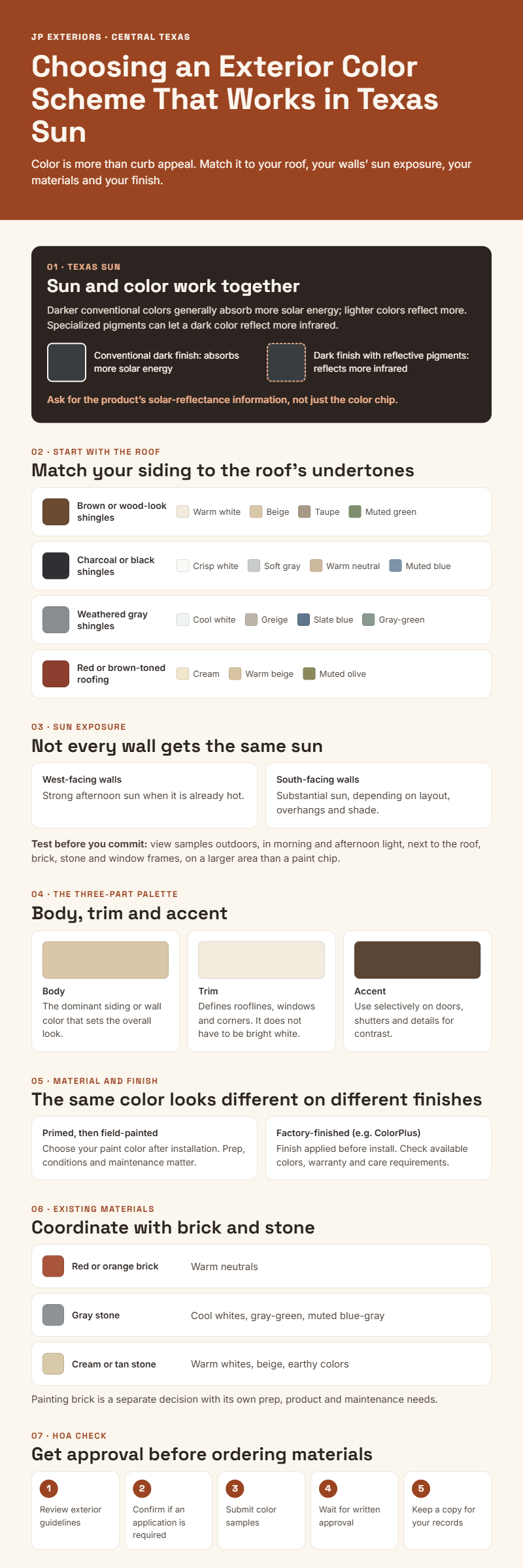
2. Choose Colors With Your Roof in Mind
Your roof is one of the largest visual elements of your home's exterior. Unless you are replacing it at the same time, its existing color will influence which siding and trim combinations look balanced.
Before choosing siding or paint, identify the main undertones in the roof.
Brown or weathered wood-look shingles: Often pair well with warm whites, beige, taupe, muted greens, and earthy colors.
Charcoal or black shingles: Can work with crisp whites, soft grays, warm neutrals, muted blues, and deeper accent colors.
Weathered gray shingles: Usually coordinate well with cool whites, greige, slate blue, and gray-green tones.
Red or brown-toned roofing: Often looks balanced with cream, warm beige, muted olive, and other earthy colors.
These are starting points, not strict rules. The roof may also have subtle color variations that are difficult to see from a small sample.
If you are planning a roof replacement soon, consider selecting the roof and siding colors together. It is easier to create a coordinated exterior when the major finishes are considered as one overall design.
3. Think About Which Walls Receive the Most Sun
Not every side of a home experiences sunlight in the same way.
In Central Texas, west-facing walls can receive strong afternoon sun when outdoor temperatures are already high. South-facing walls can also receive substantial sun exposure, depending on the home's layout, roof overhangs, and nearby shade.
This matters for both color appearance and finish durability.
A color that looks soft and neutral on a shaded sample board may appear much brighter in direct sunlight. Dark colors can also show fading, chalking, or uneven weathering differently depending on the product and exposure.
When comparing colors:
Look at samples outside rather than relying only on indoor lighting.
Check them in morning and afternoon sunlight.
View them next to the existing roof, brick, stone, and window frames.
Consider whether nearby trees or neighboring homes create permanent shade.
Ask the paint or siding manufacturer about finish performance and maintenance recommendations.
Whenever possible, evaluate a larger sample area. Small paint chips can be misleading because the same color often looks different when applied across an entire wall.
4. Build a Three-Part Color Scheme
A balanced exterior palette usually has three main components: the primary body color, a trim color, and an accent color.
Primary body color
This is the dominant color on your siding or exterior walls. It establishes the overall look of the home.
Popular directions for Texas homes include:
Warm white and cream
Light gray and greige
Sand, taupe, and beige
Muted blue-gray
Sage and other subdued greens
Deeper charcoal and earth tones
Trim color
Trim helps define rooflines, windows, corners, fascia, and other architectural details.
A trim color does not always need to be bright white. Depending on the body color, a softer cream, warm white, or contrasting dark trim may create a more cohesive appearance.
Accent color
Accent colors are best used selectively. Front doors, shutters, and certain architectural details can provide contrast without making the exterior feel too busy.
A deep blue, muted green, dark bronze, or natural wood tone can add character when it complements the main palette.
The goal is not to use three dramatically different colors. It is to create enough contrast to define the home's features while keeping the overall appearance consistent.
5. Consider the Siding Material and Finish
The same color can look different depending on the material and finish receiving it.
For example, fiber cement siding can be installed with a factory-applied finish or primed and painted in the field. Both approaches have considerations that should be reviewed before making a selection.
With James Hardie fiber cement siding, homeowners may choose a primed product that is painted after installation or a product with ColorPlus Technology, which is factory-finished.
The choice can affect the available color selections, finish appearance, maintenance expectations, and project cost.
For field-painted siding, the paint product, surface preparation, application conditions, and maintenance all matter. Sun exposure can gradually affect exterior finishes, so it is important to follow the paint manufacturer's recommendations.
For factory-finished products, review the specific product's finish warranty, approved installation details, and available colors. Do not assume every finish has the same coverage or maintenance requirements.
You can review James Hardie's product information and FAQs when comparing siding and finish options.
6. Do Not Forget Brick, Stone, and Other Existing Materials
Many Central Texas homes combine siding with brick, stone, masonry accents, or decorative columns. These materials may remain in place during an exterior renovation, which means the new color scheme needs to coordinate with them.
Pay attention to undertones:
Red or orange brick often looks more balanced with warm neutrals.
Gray stone may coordinate with cool whites, gray-green, or muted blue-gray.
Cream or tan stone can work well with warm whites, beige, and earthy colors.
Mixed stone with several colors may be easiest to coordinate with a neutral body color that picks up one of its quieter tones.
It is usually better to choose a siding color that complements the existing masonry than to select a color that competes with it.
If you are considering painting brick, remember that painting masonry is a separate decision with its own preparation, product, and long-term maintenance considerations. It should not be treated as a simple extension of choosing a siding color.
7. Check HOA Requirements Before Ordering Materials
If your home is in a neighborhood with a homeowners association, review the architectural guidelines before finalizing your colors.
Some communities require approval for any exterior color change. Others allow certain neutral palettes but restrict accent colors or specific combinations.
Approval requirements can apply even when the proposed color seems similar to the existing one. The rules depend on the community's governing documents and review process.
Before ordering siding or scheduling painting:
Review the HOA's exterior modification guidelines.
Confirm whether a color-change application is required.
Submit the requested color samples and supporting information.
Wait for written approval when the community requires it.
Keep a copy of the approval for your project records.
Taking care of this early can help prevent delays after materials have been selected.
8. Test the Complete Palette Before Committing
One of the most common mistakes homeowners make is choosing each exterior color separately.
A siding color may look great on its own but clash with the roof. A trim color may appear too bright next to the brick. An accent color may look subtle on a small sample but become overwhelming across a large surface.
Instead, evaluate the complete combination.
A simple way to do this is to gather samples of the proposed body, trim, and accent colors, then compare them against the roof and any existing masonry. Look at the samples outside and from several distances.
If you are replacing siding, ask whether larger product samples are available. If you are painting, use sample boards or test areas in locations that receive different amounts of sunlight.
Give yourself time to view the palette in changing light before making a final decision.
A Few Exterior Color Combinations to Consider
These combinations can be useful starting points for Central Texas homes. The best choice depends on the roof, architecture, existing materials, and personal preference.
Overall Style | Main Body Color | Trim | Accent |
|---|---|---|---|
Warm and traditional | Cream or warm beige | Soft white | Dark bronze |
Clean and modern | Light greige | Bright or warm white | Charcoal |
Natural and understated | Sage green | Cream | Deep brown |
Coastal-inspired | Muted blue-gray | White | Navy |
Contemporary contrast | Light gray | Dark charcoal | Natural wood tone |
Always compare actual product samples. Color names and screen previews are not reliable substitutes for viewing the finish in natural light.
The Bottom Line: Choose a Color That Works With the Whole Exterior
The best exterior color scheme is one that fits the home's architecture, coordinates with existing materials, and makes sense for the conditions the home faces.
In Texas, sunlight and heat deserve consideration, but color is only one part of exterior performance. The siding material, paint or factory finish, wall assembly, installation quality, and maintenance all contribute to how the exterior performs over time.
If you are already planning to replace your siding, it is a good opportunity to evaluate the entire exterior. You can consider color, trim, insulation opportunities, and any repairs that may become visible once the old siding is removed.
A little planning before the project begins can help you avoid choosing a color that looks great on a sample but feels wrong once it covers the whole house.
Get Started With a Free Roofing Consultation
JP Exteriors helps Central Texas homeowners update and protect their home's exterior with siding replacement, exterior painting, roofing, windows, doors, and outdoor living improvements. If you are considering a new exterior color scheme or planning a siding project, our team can help you review the options and determine what makes sense for your home.
Frequently Asked Questions
What exterior colors work best for Texas homes?
There is no single best color for every Texas home. Warm whites, cream, greige, muted greens, and lighter earth tones are popular options. The best choice depends on the home's roof, architecture, existing brick or stone, and sun exposure.
Do dark exterior colors make a house hotter?
Conventional dark exterior finishes generally absorb more sunlight than lighter finishes. However, specialized reflective pigments can improve the solar reflectance of some darker products. If heat absorption is a concern, compare product performance information rather than relying on color alone.
Do lighter siding colors fade less in Texas?
Not necessarily. Fade resistance depends on the finish, pigments, product quality, installation, and exposure. Some colors and finishes may show weathering more noticeably than others. Ask the manufacturer about the specific product's finish warranty and maintenance requirements.
Should my siding match my roof?
Your siding does not have to match your roof, but the colors should coordinate. Consider the roof's undertones when selecting the body and trim colors. If both are being replaced, choosing them together can make it easier to create a balanced exterior.
Is factory-finished siding better than field-painted siding?
Each option has advantages. Factory-finished siding offers a controlled finish applied before installation, while primed siding allows homeowners to select a field-applied paint color. Compare the product warranties, color options, finish expectations, and project costs before deciding.
Can I change my home's exterior color if I have an HOA?
That depends on your community's governing documents and architectural review requirements. Some HOAs require written approval before any exterior color change, even if the new color is similar to the existing one. Check the rules before ordering materials or scheduling work.
When should I choose my siding color?
Choose your color before materials are ordered and installation begins. If you are also replacing the roof, consider coordinating both selections. Reviewing larger samples outdoors and checking HOA requirements early can help prevent delays.
Remember: When you refer a friend or neighbor for windows, siding, roofing, or door replacement, you can earn up to $250 through the JP Exteriors Referral Program.
Subscribe to JP Exteriors's Blog



Comments