How Much Should You Budget for New Gutters?
Gutters are easy to overlook until they stop doing their job.
Maybe water spills over the edges during a heavy Texas rainstorm. Maybe the existing gutters are pulling away from the fascia, leaking at the corners, or sending water toward the foundation. Or perhaps you're replacing your roof and want to make sure the drainage system is ready for the next storm.
Whatever the reason, one of the first questions homeowners ask is how much new gutters will cost.
In Central Texas, seamless aluminum gutters are a common choice. But even when two homes use the same material, installation prices can vary based on the gutter size, roofline, number of downspouts, accessibility, and condition of the existing fascia.
The decision between 5-inch and 6-inch gutters also matters. A larger gutter may be appropriate for a roof that produces substantial runoff, but bigger isn't automatically better for every home.
Let's look at what goes into the cost and how to compare your options.
1. What Do Seamless Gutters Cost in Austin?
Gutter installation is generally priced by the linear foot, not by the square footage of the house or roof.
That means a large home with a simple roofline may need less gutter work than a smaller home with several roof sections, valleys, and complicated drainage points.
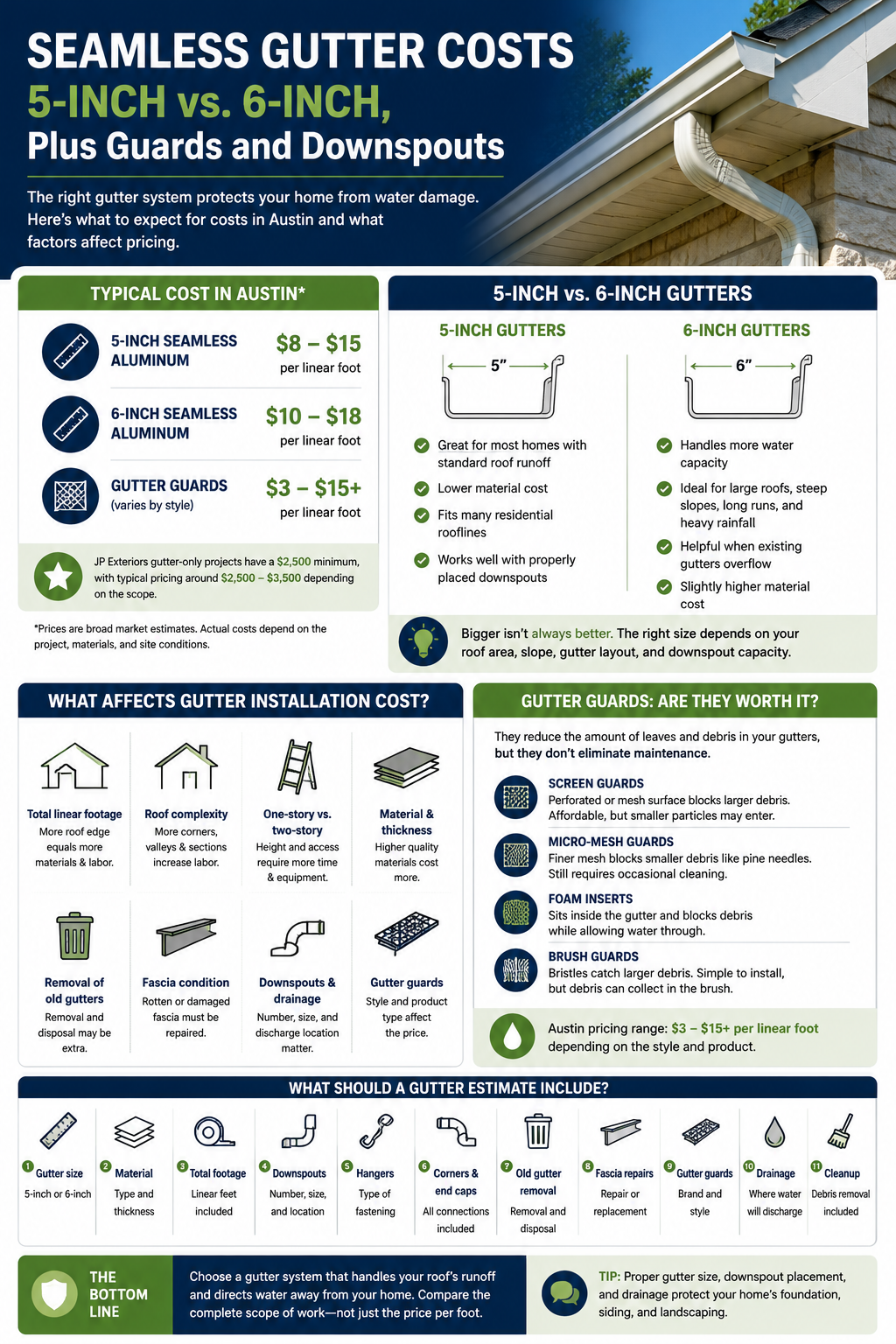
Recent Austin-area pricing guides show broad installed ranges for standard seamless aluminum gutters. As a general planning reference:
5-inch seamless aluminum: approximately $8–$15 per linear foot
6-inch seamless aluminum: approximately $10–$18 per linear foot
Gutter guards: approximately $3–$15 or more per linear foot, depending on the product
These are broad market estimates, not guaranteed prices. Some estimates include downspouts, removal, and cleanup, while others price those items separately. Material thickness, roof access, and the scope of the project can also change the total.
For JP Exteriors customers, gutter-only projects have a $2,500 minimum, with typical gutter-only project pricing around $2,500–$3,500 depending on the scope.
The important thing is to compare complete proposals. A low per-foot price may not include everything needed to finish the job.
2. Five-Inch vs. Six-Inch Gutters: What's the Difference?
One of the most common decisions during gutter replacement is whether to install standard 5-inch gutters or upgrade to 6-inch gutters.
Both sizes are widely used, but they are designed for different drainage demands.
Five-inch gutters
Five-inch K-style gutters are a common residential option. They can be suitable for many homes with standard roof configurations and properly designed downspouts.
Potential advantages include:
Lower material cost in many installations
A familiar profile that works with many residential rooflines
Adequate capacity for many standard drainage applications
Compatibility with a wide range of gutter accessories
For a home with moderate roof runoff and an appropriately designed drainage system, 5-inch gutters may be all that's needed.
Six-inch gutters
Six-inch gutters provide a larger channel and can accommodate more water when the rest of the drainage system is properly sized.
They may be worth considering when a home has:
Large roof sections draining into one gutter run
Steep roof slopes that send water into gutters quickly
Long gutter runs
Roof valleys that concentrate runoff
Heavy rainfall exposure
A roof configuration that regularly overwhelms the existing system
A 6-inch gutter may cost more, but that additional capacity can be useful when the roof produces more runoff than a standard system can comfortably handle.
Is six-inch always better?
No. Gutter size is only one part of the drainage system.
The roof area draining into each section, gutter slope, outlet placement, downspout size, and number of downspouts all influence how well the system handles water.
A 6-inch gutter connected to undersized or poorly placed downspouts can still overflow.
The right size should be based on the roof and drainage layout, not simply the idea that bigger must be better.
3. What Do Downspouts Add to the Cost?
Downspouts are just as important as the gutters themselves.
Gutters collect water along the roofline, but downspouts carry that water away from the roof and toward a suitable discharge location.
If there are too few downspouts, or if they are too small for the amount of runoff, water may back up in the gutter during heavy rain.
The number and placement of downspouts depend on the roof layout and the drainage requirements of each gutter section.
When reviewing an estimate, ask:
How many downspouts are included?
What size are they?
Where will they be located?
Are elbows and extensions included?
Where will the water discharge?
Are underground drainage connections included or priced separately?
A good gutter system should not simply move water off the roof. It should direct it away from areas where it can cause problems.
4. Are Gutter Guards Worth the Extra Cost?
Gutter guards are designed to reduce the amount of leaves, twigs, and other debris that enters the gutter system.
They can be helpful for homes surrounded by trees, especially when gutters are difficult to access or require frequent cleaning.
However, not every gutter guard works the same way.
Common options include:
Screen guards: These use a perforated or mesh surface to keep larger debris out. They are often among the more affordable options, but smaller particles may still enter.
Micro-mesh guards: These use a finer mesh to block smaller debris. They can be useful in areas with pine needles and smaller organic material, but the surface may still need occasional cleaning.
Foam inserts: These sit inside the gutter and allow water to pass through while attempting to block larger debris. Their performance and maintenance requirements depend on the product and environment.
Brush-style guards: These use bristles inside the gutter to catch larger debris. They can be relatively simple to install, but debris may collect within the brush and require maintenance.
How much do gutter guards cost?
Austin-area estimates commonly place gutter guard installation in a broad range of approximately $3–$15 or more per linear foot, depending on the style and product.
Higher-end micro-mesh systems may cost more.
Before choosing a product, ask what it is designed to block, how it is attached, whether it affects the manufacturer's gutter warranty, and how it should be maintained.
Do gutter guards eliminate cleaning?
No. Gutter guards can reduce the amount of debris entering the system, but they do not make gutters maintenance-free.
Leaves and dirt can collect on top of the guards, and downspouts can still become clogged.
Think of guards as a maintenance-reduction option rather than a guarantee that you will never need to clean your gutters again.
5. What Makes One Gutter Installation More Expensive Than Another?
Two estimates for what appears to be the same home can differ significantly. Here are some of the reasons.
Total linear footage
The more roof edge that needs gutters, the more material and installation labor are generally required.
Remember that not every roof edge necessarily needs a gutter. The layout should be based on where runoff needs to be collected and directed.
Number of corners and roof sections
A simple rectangular roofline is generally easier to work with than one with several corners, valleys, and intersecting sections.
Additional corners and connections require more fabrication and installation details.
One-story vs. two-story construction
Two-story homes may require additional setup, equipment, and labor because of the height and accessibility of the roofline.
Steep roofs can also make installation more complicated.
Gutter material and thickness
Aluminum is a popular residential option, but not all aluminum gutters are identical.
The material thickness, finish, and profile can affect cost and durability. Ask whether the proposal identifies the gutter specifications rather than simply listing aluminum gutters.
Existing gutter removal
If old gutters are already installed, removal and disposal may be included in the project or listed as a separate charge.
Make sure the estimate explains what happens to the existing system.
Fascia and soffit condition
Gutters attach to the fascia, so the condition of the underlying material matters.
If the fascia is rotten, deteriorated, or pulling away from the structure, it may need to be repaired before new gutters can be installed.
Installing new gutters over damaged attachment points does not solve the underlying problem.
Drainage extensions
A downspout that empties directly beside the home may not direct water far enough away from the foundation.
Extensions, splash blocks, or underground drainage connections may be needed depending on the property.
These features can add to the project cost, but they should be considered as part of the complete drainage plan.
6. Why Seamless Gutters Are Popular
Traditional sectional gutters are assembled from shorter pieces joined together along the roofline.
Seamless gutters are formed to the required length on-site, which reduces the number of joints along each straight run.
That can mean fewer locations where leaks may develop.
Seamless aluminum gutters are popular because they offer:
Fewer seams along straight sections
A clean, continuous appearance
Custom lengths for the home's roofline
A range of colors to coordinate with exterior finishes
A relatively lightweight, corrosion-resistant material
However, seamless does not mean completely joint-free.
Corners, end caps, outlets, and downspout connections still require seams and proper sealing. Installation quality matters just as much as the product itself.
7. Why Gutter Placement Matters More Than Homeowners Realize
A gutter system should be designed around the way water leaves the roof.
A roof valley can concentrate a large amount of runoff into a relatively small area. If that water reaches a gutter section that is undersized or poorly positioned, it may overflow even if the rest of the system works correctly.
The same is true when a long gutter run has inadequate slope or too few outlets.
During a replacement project, it is worth checking:
Whether the gutter is positioned correctly beneath the roof edge
Whether the slope allows water to reach the outlets
Whether roof valleys discharge into appropriate locations
Whether downspouts are adequately sized
Whether water is directed away from the foundation
A properly planned drainage system should account for the roof's shape and the amount of runoff each section receives.
8. What Should a Gutter Estimate Include?
When comparing estimates, make sure you are looking at the same scope of work.
A detailed proposal should identify:
Gutter size: Are you getting 5-inch or 6-inch gutters?
Material: What type and thickness of aluminum are included?
Total footage: How many linear feet will be installed?
Downspouts: How many are included, and what sizes?
Hangers: What type of fastening system will be used?
Corners and end caps: Are all connections included?
Old gutter removal: Is removal and disposal included?
Fascia repairs: Are repairs included or priced separately?
Gutter guards: What brand and style are being installed?
Drainage: Where will the downspouts discharge?
Cleanup: Will leftover materials and debris be removed?
A detailed estimate makes it easier to compare contractors and understand why one proposal may cost more than another.
Which Gutter System Makes the Most Sense?
The right system depends on your home's roofline, drainage requirements, and budget.
Choose 5-inch seamless gutters if: Your roof has standard drainage demands and the system can be properly sized with appropriate downspouts.
Consider 6-inch seamless gutters if: Your roof has larger drainage areas, steep slopes, concentrated runoff, or other conditions that call for additional capacity.
Consider gutter guards if: Your property has substantial tree coverage or you want to reduce the amount of debris entering the gutters.
Prioritize downspout placement if: Water currently collects near the foundation or certain roof sections regularly overflow.
The goal is not to purchase the largest or most expensive system. It is to install a system that handles the water your roof produces and directs it where it needs to go.
The Bottom Line: Gutters Are Part of Your Home's Drainage System
New gutters are more than a cosmetic upgrade. They help manage roof runoff and direct water away from the exterior of your home.
When comparing 5-inch and 6-inch gutters, look beyond the size and consider the roof area, slope, downspouts, and drainage layout.
Gutter guards may reduce debris buildup, but they do not eliminate maintenance. And even the best gutter system cannot compensate for damaged fascia, poor installation, or inadequate drainage away from the house.
Before choosing a contractor, compare the complete scope of work and make sure the estimate explains exactly what is included.
Get Started With a Free Roofing Consultation
JP Exteriors helps Central Texas homeowners protect and improve their homes with seamless gutter installation, roofing, siding, windows, doors, and outdoor living projects. If your gutters are overflowing, deteriorating, or simply need to be replaced, our team can help you review the options for your home.
Frequently Asked Questions
How much do seamless gutters cost in Austin?
Austin-area estimates vary, but standard seamless aluminum installation commonly falls within a broad range of approximately $8–$18 per linear foot, depending on size, access, material, and project scope. JP Exteriors' typical gutter-only project pricing is around $2,500–$3,500, with a $2,500 minimum.
Are 6-inch gutters worth the extra cost?
They can be, particularly for homes with large roof sections, steep slopes, or concentrated runoff. The correct size depends on the roof area, gutter slope, outlet placement, and downspout capacity.
Are seamless gutters better than sectional gutters?
Seamless gutters have fewer joints along straight runs, which reduces the number of potential leak points. However, corners and connections still need proper sealing and installation.
Do gutter guards eliminate the need for cleaning?
No. They can reduce debris entering the gutter, but leaves, dirt, and other material can still collect on the guard surface. Downspouts may also need occasional cleaning.
How many downspouts does my house need?
The number depends on the length and layout of the gutter runs, roof area, gutter size, slope, and expected runoff. A properly designed system should distribute drainage rather than relying on a single outlet for an oversized section.
Should I replace my gutters when I replace my roof?
Not always, but it is a good opportunity to inspect the gutter system. If gutters are damaged, undersized, or poorly positioned, coordinating the work with a roof replacement may help avoid scheduling separate projects later.
Can bad gutters cause foundation problems?
Gutters that overflow or discharge water close to the house can contribute to excess moisture around the foundation. The overall effect depends on soil conditions, grading, drainage, and other site factors. Properly directed downspouts are an important part of managing roof runoff.
How often should gutters be cleaned?
It depends on the amount of tree coverage, roof debris, and local conditions. Homes surrounded by trees may need more frequent attention than homes with little overhead vegetation. Inspect the system periodically, especially after major storms.
Remember: When you refer a friend or neighbor for windows, siding, roofing, or door replacement, you can earn up to $250 through the JP Exteriors Referral Program.
Subscribe to JP Exteriors's Blog




Comments