How Much of Your Home's Exterior Should You Replace at Once?
When homeowners start planning an exterior renovation, they often begin with one problem.
Maybe the siding is faded or deteriorating. Maybe the windows are drafty or difficult to operate. Maybe the roof is getting older, the gutters are failing, and the front of the house needs an update.
Then the project starts growing.
If you're already replacing the siding, should you replace the windows too? Does it make sense to include the roof? Would a complete exterior makeover be a better investment than tackling everything separately?
There isn't one answer for every home. The right approach depends on the condition of each exterior component, your budget, how long you plan to stay in the house, and whether the projects share materials, labor, or installation details.
For Central Texas homeowners, there are three common ways to approach an exterior renovation:
Siding replacement only
Siding and window replacement together
A coordinated full exterior makeover
Let's compare what each option involves and when it may make sense.
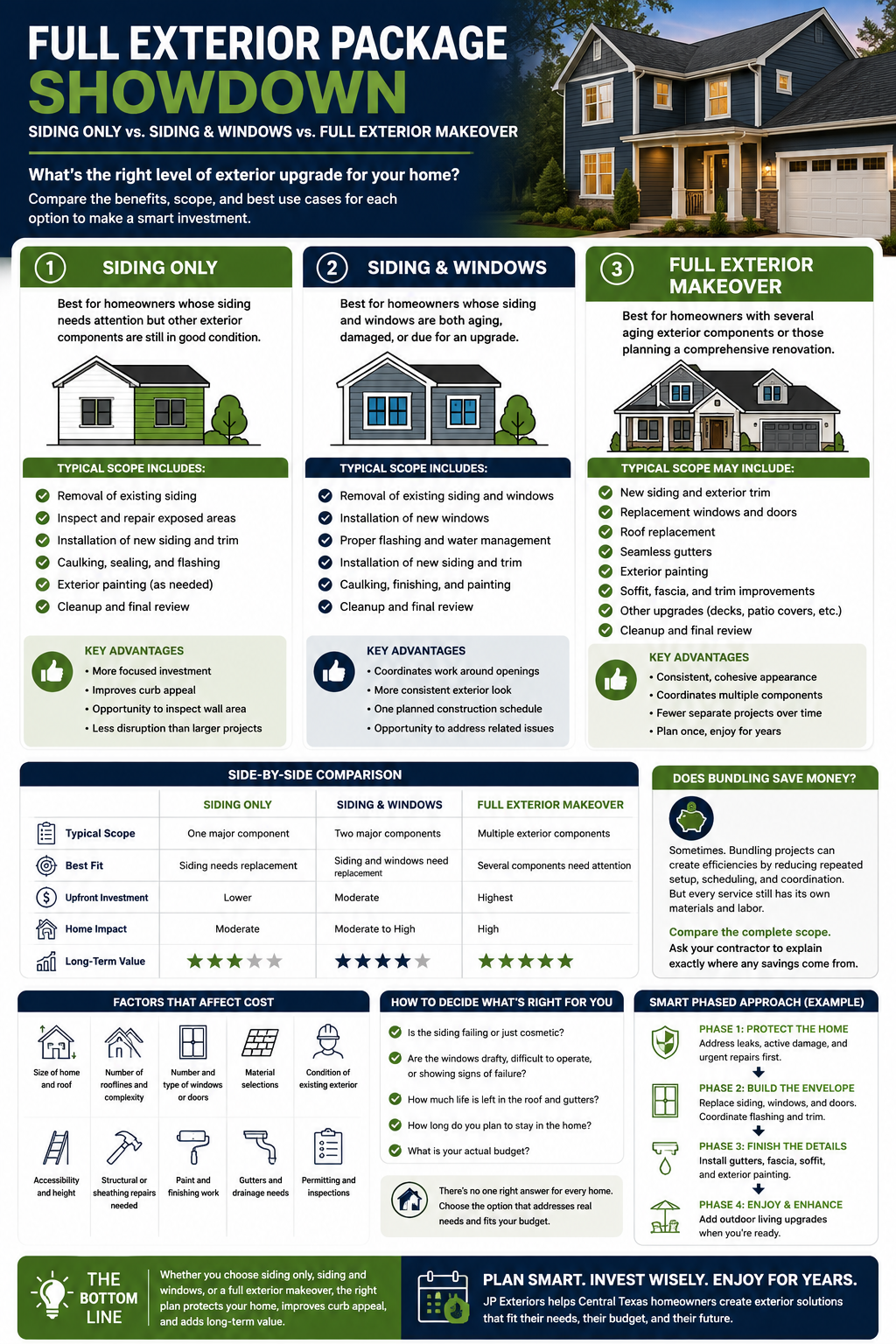
1. Option One: Siding Replacement Only
Best for homeowners whose siding needs attention but whose other exterior components are still in good condition.</emphasis>
Siding has a major impact on the appearance and weather protection of a home. When it begins to deteriorate, crack, swell, or show signs of moisture damage, replacement may be the most practical solution.
A siding-only project focuses on removing the existing siding and installing new material without automatically replacing windows, roofing, or other exterior components.
What does a siding-only project include?
Depending on the home and proposal, the work may include:
Removal and disposal of existing siding
Inspection of the exposed wall area
Replacement of damaged or deteriorated sheathing where included
Installation of new siding
Replacement of specified trim and related components
Caulking and sealing at appropriate transitions
Exterior painting when required
Cleanup and final project review
For many Central Texas homes, James Hardie fiber cement siding is an option worth considering. It offers a different level of durability and maintenance characteristics than older wood siding, and it is available in several profiles and finish options.
Advantages of replacing siding alone
A more focused investment: You can address the most visible or deteriorated part of the exterior without committing to a larger renovation.
Improved curb appeal: New siding can dramatically change the appearance of a home, especially when paired with updated trim and a fresh color scheme.
An opportunity to inspect the wall: Removing old siding can reveal areas that need attention, including damaged sheathing or moisture-related deterioration.
Less disruption than a larger renovation: A siding-only project generally involves fewer separate trades and decisions than a complete exterior makeover.
What should you consider?
If your windows are nearing the end of their useful life, installing new siding around them may mean revisiting those same areas when the windows are eventually replaced.
That does not mean you should replace perfectly good windows simply because the siding is coming off. It means you should evaluate their condition before deciding.
The same applies to the roof, gutters, and exterior trim. If those components are already deteriorating, it may be worth considering whether coordinating the work now makes more sense.
2. Option Two: Siding and Window Replacement Together
<emphasis>Best for homeowners whose siding and windows are both aging, damaged, or due for an upgrade.</emphasis>
This is often a practical middle ground between a single-component project and a complete exterior renovation.
Windows and siding are closely connected. Replacing both during the same renovation creates an opportunity to coordinate the window installation, flashing, trim, and siding details.
Instead of completing one project and later reopening the same exterior areas for another, the contractor can plan the transitions together.
What does a siding and window project include?
Depending on the scope, a combined project may include:
Removal of existing siding
Removal of selected existing windows
Installation of new windows
Proper flashing and water-management details
Inspection and repair of exposed wall areas where included
Installation of new siding and trim
Exterior caulking and finishing
Painting when required
Final cleanup and inspection
The exact scope matters. A proposal should explain which windows are being replaced, what happens to the existing trim, how flashing is handled, and whether any interior finish work is included.
Why coordinate windows and siding?
Better coordination around openings
Window replacement involves more than putting a new unit into an existing opening. The opening needs appropriate preparation, flashing, and integration with the surrounding wall system.
When siding is also being replaced, those details can be planned as part of one coordinated project.
A more consistent exterior appearance
New windows and siding can make a home look substantially different. Coordinating frame colors, trim, siding profiles, and exterior paint helps create a more unified result.
One planned construction schedule
Instead of arranging separate projects months or years apart, homeowners can coordinate the work and plan around one overall renovation schedule.
An opportunity to address related issues
Removing siding can expose areas around windows that need attention. Coordinating the work can make it easier to identify and address those conditions within the agreed project scope.
When might this option not make sense?
If your existing windows are relatively new, operate properly, and are in good condition, replacing them just to bundle projects may not be financially worthwhile.
Likewise, if the siding is in good shape but only a few windows need replacement, a full siding project may be unnecessary.
The goal is to coordinate work that actually needs to be done, not add projects simply to create a larger package.
3. Option Three: The Full Exterior Makeover
<emphasis>Best for homeowners with several aging exterior components or those planning a more comprehensive renovation.</emphasis>
A full exterior makeover takes a broader look at the home.
Rather than focusing on one or two components, the project evaluates the exterior as a complete system. Depending on the home's needs, it may include siding, windows, roofing, gutters, doors, exterior painting, and other improvements.
Not every full exterior project includes every service. The scope should be based on the property's condition and the homeowner's priorities.
What might a full exterior makeover include?
A comprehensive project could involve:
New siding and exterior trim
Replacement windows
Roof replacement
Seamless gutter installation
Entry or patio door replacement
Exterior painting
Soffit and fascia improvements
Related flashing and water-management details
Some homeowners may also choose to add an outdoor living project, such as a new deck, pergola, or patio cover. Those improvements can be coordinated with the larger renovation, although they involve separate design and construction considerations.
Advantages of a full exterior renovation
A consistent appearance
Updating several exterior components together gives you more control over how the roof, siding, windows, trim, and doors work together visually.
Coordinated construction details
Certain components meet or overlap. Roof edges, siding transitions, window openings, flashing, fascia, and gutters all need to work together to manage water.
Planning the work as a complete project can help prevent one improvement from interfering with another.
Fewer separate project decisions
Instead of choosing materials and colors several times over several years, you can evaluate the overall design at the beginning.
Potential scheduling efficiencies
When multiple projects are coordinated, some setup, communication, material planning, and scheduling can be consolidated. Whether that produces meaningful savings depends on the actual scope and how the work is organized.
What should you consider?
A full exterior makeover requires a larger upfront investment and more planning.
There may be additional material lead times, permitting requirements, and coordination between different crews.
It also means more activity around your home. Parking, access, pets, landscaping, noise, and daily routines should all be considered before construction begins.
A larger project isn't automatically the better choice. It is only worthwhile when the work addresses real needs and fits your budget.
4. Side-by-Side: Which Project Level Fits Your Home?
Project Level | Typical Scope | Main Advantage | Best Fit |
|---|---|---|---|
Siding only | Siding, trim, related repairs, painting as specified | Focuses investment on one major exterior component | Siding needs replacement; other components are in good condition |
Siding + windows | Siding, window replacement, flashing, trim, related repairs | Coordinates work around window openings | Both siding and windows are aging or need replacement |
Full exterior makeover | Siding, windows, roofing, gutters, doors, and other selected upgrades | Coordinates multiple exterior improvements | Several major exterior components need attention |
The best option is not necessarily the largest package. It is the one that addresses the home's actual condition without paying to replace components that still have plenty of useful life.
5. Does Bundling Exterior Projects Actually Save Money?
This is one of the biggest questions homeowners ask.
The honest answer is: sometimes.
Combining projects can create efficiencies, but it does not guarantee that the total cost will be lower than completing each project separately.
Potential efficiencies include:
Coordinating measurements and material ordering
Reducing repeated scheduling and project setup
Planning window and siding transitions together
Coordinating roof-edge, fascia, and gutter work
Reducing the need for separate contractor visits
Making color and product selections together
However, each additional service still has its own materials, labor, equipment, and installation requirements.
For example, replacing a roof and replacing windows do not automatically share much installation labor. Combining them may simplify project management, but the actual construction work remains separate.
Siding and windows generally have more direct overlap because the work meets around the window openings.
The best way to evaluate bundling is to compare two clearly defined proposals:
The cost and scope of completing the projects separately
The cost and scope of coordinating them under one project plan
Ask the contractor to identify exactly where any savings come from rather than relying on a general promise that a package is cheaper.
6. What Order Should Exterior Work Happen In?
When several components are being replaced, sequencing matters.
The correct order depends on the home's construction, the products being installed, and the condition of the existing exterior. However, there are some practical considerations.
Address active water problems first
If the roof is leaking or water is entering through the wall, those problems should be addressed before cosmetic improvements.
Installing new siding or painting over an active moisture problem will not solve the underlying issue.
Coordinate roofing with siding
When both the roof and siding are being replaced, the roof-to-wall transitions should be planned together.
Roofing details, flashing, and water-management components need to be coordinated so that runoff is directed properly.
Coordinate windows with siding
When replacing both, the window installation and flashing details should be planned with the new siding.
The installation sequence depends on the window type and manufacturer's instructions, but the goal is to create a properly integrated opening rather than treating the window and siding as unrelated projects.
Plan gutters around roof and fascia work
If the roof edge, fascia, or soffit is being replaced, gutter installation should be coordinated with that work.
Installing gutters too early can mean removing or adjusting them later.
Finish with the details
Exterior painting, trim touch-ups, final caulking where appropriate, and cleanup should be scheduled according to the products and installation requirements.
The contractor should provide a project sequence before work begins so homeowners understand what happens first and why.
7. How Much Should You Budget?
There is no reliable single price for a full exterior makeover because homes differ in size, condition, materials, and project scope.
A smaller siding-only project may involve substantially less work than a renovation that includes multiple window openings, a roof replacement, gutters, and exterior doors.
For planning purposes, start by separating the project into components:
Siding and trim
Windows and doors
Roofing
Gutters and drainage
Exterior painting
Additional repairs or outdoor living improvements
Then request pricing for each component and for the coordinated project as a whole.
JP Exteriors publishes an exterior remodeling pricing guide to help Central Texas homeowners explore planning ranges for different services.
Remember that preliminary pricing is not a substitute for measurements and a property-specific proposal. Existing damage, material selections, access, and installation details can change the final cost.
8. How to Decide Which Package Is Right for You
Before choosing a project level, take a step back and evaluate the condition of the entire exterior.
Ask yourself:
Is the siding failing, or does it simply need a cosmetic update?
Cracked, deteriorated, or moisture-damaged siding may need replacement. If the material is still sound, painting or a smaller repair may be appropriate depending on the product and condition.
Are the windows showing signs of failure?
Difficulty operating, damaged frames, failed insulated-glass seals, and persistent drafts may indicate that replacement deserves consideration.
How much life is left in the roof?
If the roof is approaching the point of replacement, it may be worth coordinating that work with siding or fascia improvements.
Are the gutters functioning correctly?
Overflowing gutters, improper drainage, and deteriorated sections should be evaluated as part of the overall exterior plan.
How long do you plan to stay in the home?
A homeowner planning to stay for many years may prioritize long-term durability and a coordinated appearance. Someone preparing to sell may have different priorities.
What is your actual budget?
A phased renovation can be a sensible option. You do not have to complete every exterior improvement at once.
9. Can You Complete a Full Exterior Makeover in Phases?
Absolutely.
If several parts of your home need attention but the entire project does not fit your current budget, a phased approach may be more practical.
The important thing is to plan the phases together, even if the construction happens over time.
For example:
Phase 1: Protect the home.
Address active roof leaks, water intrusion, deteriorated siding, and other conditions that could lead to additional damage.
Phase 2: Coordinate the building envelope.
Plan window and door replacement with siding work where appropriate, including flashing and trim details.
Phase 3: Complete drainage and finishing work.
Coordinate gutters, downspouts, fascia, painting, and other exterior details with the preceding work.
Phase 4: Upgrade outdoor living.
Once the home's essential exterior components are in good condition, consider a deck, patio cover, pergola, or other outdoor improvement.
This is only an example. The actual sequence should be based on the home's condition and the products involved. A contractor should help identify which projects are urgent, which can be coordinated, and which can safely wait.
The Bottom Line: The Best Exterior Package Is the One Your Home Actually Needs
Replacing siding alone, combining siding and windows, or completing a full exterior makeover can all be smart decisions.
The difference comes down to the condition of your home and how the projects fit together.
If only the siding needs attention, there may be no reason to replace perfectly good windows. If both siding and windows are aging, coordinating the work can make sense. And if the roof, gutters, siding, and other exterior components are all approaching replacement, a comprehensive plan may help organize the work more effectively.
You do not have to renovate everything at once to make a good decision. You do need a clear understanding of what needs attention now, what can wait, and how today's work may affect tomorrow's project.
Get Started With a Free Roofing Consultation
JP Exteriors helps Central Texas homeowners improve their homes with James Hardie fiber cement siding, window and door replacement, roofing, seamless gutters, exterior painting, decks, patio covers, and other outdoor living projects.
Whether you need one exterior upgrade or are considering a larger renovation, our team can help you review the options and plan a project around your home's needs.
Frequently Asked Questions
Is it cheaper to replace siding and windows at the same time?
It can create scheduling and installation efficiencies because the work overlaps around window openings, flashing, and exterior trim. However, combining the projects does not guarantee a lower total price. Compare the complete scope and ask where any savings come from.
Should I replace my windows before or after my siding?
When both are being replaced, the work should be coordinated so the window installation, flashing, and new siding integrate properly. The exact sequence depends on the window type and installation instructions.
Should I replace my roof before replacing siding?
If both need replacement, roof-to-wall transitions and flashing should be planned together. The contractor should establish a sequence that protects the wall system and avoids having new work disturbed by later construction.
What is included in a full exterior remodel?
It depends on the home and the proposal. A full exterior remodel may include siding, windows, roofing, gutters, doors, trim, and painting. Outdoor living improvements may also be added as separate parts of a broader renovation.
Can I replace my siding now and my windows later?
Yes. Many homeowners phase exterior projects over time. The important thing is to evaluate the windows before installing new siding and discuss how a future replacement may affect the new exterior details.
Does bundling exterior projects always save money?
No. Bundling may reduce repeated setup, scheduling, and coordination, but every service still requires its own materials and installation labor. Savings depend on the specific project and how much work can genuinely be shared.
How do I know whether my home needs a full exterior makeover?
Look at the condition of the siding, windows, roof, gutters, doors, and trim. If several components are deteriorating or nearing replacement at the same time, a coordinated assessment can help determine whether one project or a phased renovation makes more sense.
Can JP Exteriors handle multiple exterior projects?
JP Exteriors offers siding, window and door replacement, roofing, gutters, exterior painting, decks, patio covers, pergolas, and other exterior remodeling services throughout its Central Texas service area. The appropriate project scope depends on the property and the work requested.
Remember: When you refer a friend or neighbor for windows, siding, roofing, or door replacement, you can earn up to $250 through the JP Exteriors Referral Program.
Subscribe to JP Exteriors's Blog


Comments