Roofing Material Showdown: Architectural Shingles vs. Class 4 Shingles vs. Standing Seam Metal
In Central Texas, choosing a new roof involves more than picking a color. Homeowners have to consider intense summer heat, strong winds, occasional severe hail, and how long they plan to stay in their homes.
Three popular options are architectural asphalt shingles, Class 4 impact-resistant shingles, and standing seam metal roofing. Each offers a different balance of upfront cost, durability, appearance, and long-term value.
So which one makes the most sense for an Austin-area home?
Let's compare the three options, look at what they typically cost in Central Texas, and explain what homeowners should understand before choosing a roofing system.
The Quick Comparison: Good, Better, Best
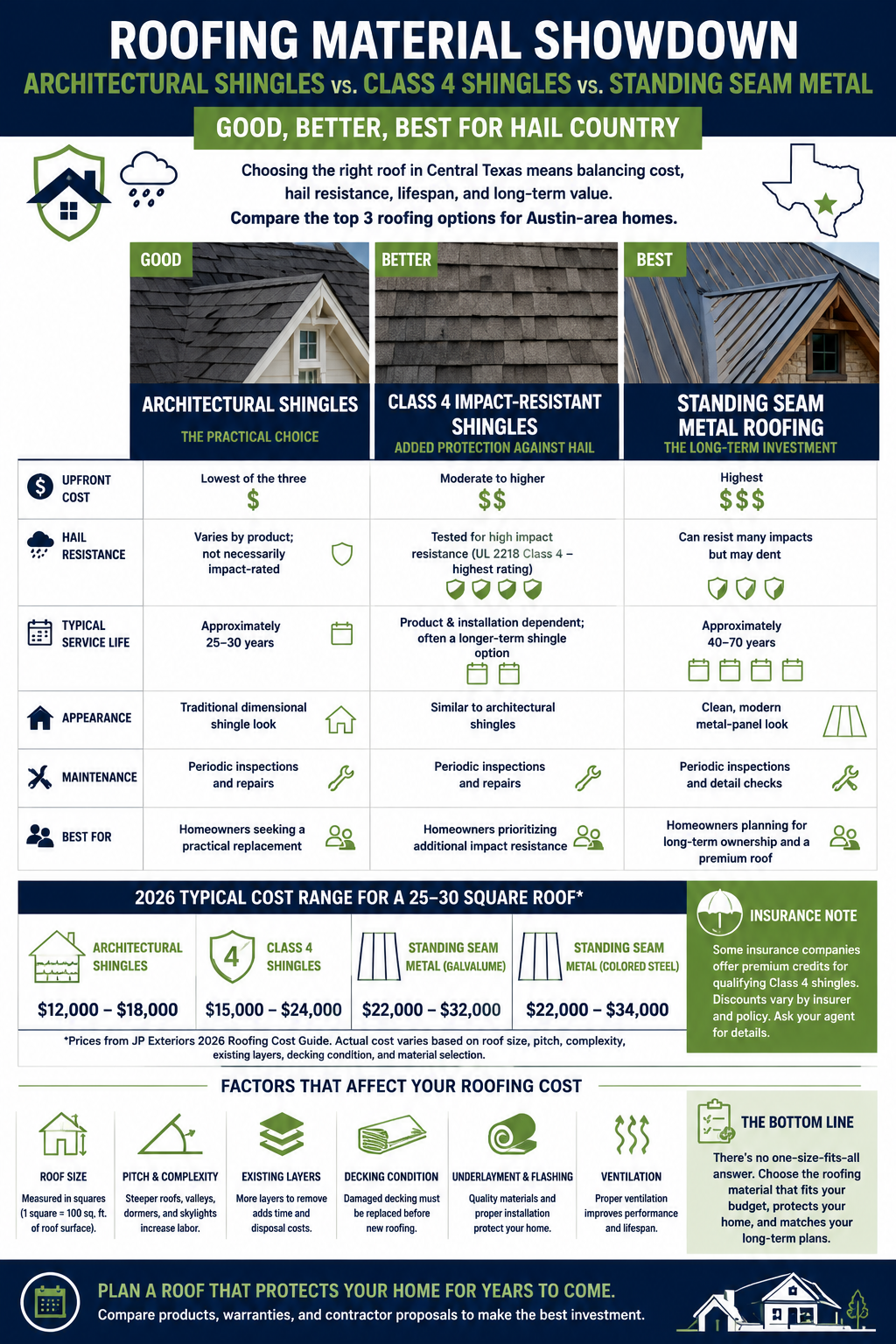
Feature | Architectural Shingles | Class 4 Shingles | Standing Seam Metal |
|---|---|---|---|
Upfront cost | Lowest of the three | Moderate to higher | Highest |
Hail resistance | Varies by product; not necessarily impact-rated | Tested for high impact resistance | Can resist many impacts but may dent |
Typical service life | Approximately 25–30 years | Product and installation dependent; often a longer-term shingle option | Approximately 40–70 years |
Appearance | Traditional dimensional shingle look | Similar to architectural shingles | Clean, modern metal-panel appearance |
Maintenance | Periodic inspections and repairs | Periodic inspections and repairs | Periodic inspections and detail checks |
Best for | Homeowners seeking a practical replacement | Homeowners prioritizing additional impact resistance | Homeowners planning for long-term ownership and a premium roof |
These are general comparisons, not guarantees. Actual performance and service life depend on the specific product, installation, roof design, ventilation, weather exposure, and maintenance.
1. Architectural Shingles: The Practical Choice
Architectural shingles are one of the most common roofing choices for homes throughout Austin and the surrounding communities. They offer a dimensional appearance, a wide selection of colors, and a relatively affordable installation compared with premium roofing systems.
Unlike older three-tab shingles, architectural shingles are typically made with multiple layers that create a thicker, more textured appearance.
What do architectural shingles cost in Central Texas?
JP Exteriors' 2026 planning range for a typical 25–30-square roof is approximately $12,000–$18,000 for architectural asphalt shingles.
The final cost depends on the roof's size, pitch, accessibility, existing layers, decking condition, and the specific shingle system selected.
What are the advantages?
Cost-effective: Architectural shingles offer a good balance between price and performance.
Traditional appearance: They complement many home styles and are available in numerous colors.
Straightforward installation: Experienced roofing crews are familiar with these systems.
Manufacturer options: Homeowners can choose from established brands and different warranty levels.
What should homeowners consider?
Standard architectural shingles should not automatically be considered hail-resistant. Some products have impact-resistance classifications, but many do not.
If hail protection is a major priority, homeowners should compare the specific product's testing and classification rather than relying on the general term "architectural shingles."
Who should consider architectural shingles?
This option makes sense for homeowners who want a dependable, attractive roof without moving into the higher price range of impact-resistant shingles or metal roofing.
For many Central Texas homes, it is a practical starting point.
2. Class 4 Impact-Resistant Shingles: Added Protection Against Hail
<em>Better</em>
If hail is one of your biggest roofing concerns, Class 4 impact-resistant shingles deserve a closer look.
These shingles are tested under UL 2218, a standardized impact-resistance test. Class 4 is the highest classification under that test.
The testing evaluates how roofing materials respond to impacts from steel balls under controlled conditions. It gives homeowners a useful way to compare products, but it does not mean a roof is guaranteed to avoid damage during every hailstorm.
What do Class 4 shingles cost in Central Texas?
JP Exteriors' 2026 planning range for a typical 25–30-square roof is approximately $15,000–$24,000 for Class 4 impact-resistant shingles.
That is generally more than a standard architectural shingle installation. The additional cost may be worthwhile for homeowners who want a roofing product specifically tested for impact resistance.
What are the advantages?
Impact-resistance testing: Class 4 products meet the highest classification under UL 2218.
Hail-conscious selection: They are worth considering in areas that experience recurring hailstorms.
Familiar appearance: Many Class 4 products look similar to traditional architectural shingles.
Potential insurance savings: Some insurance companies offer premium credits for qualifying impact-resistant roofing materials.
Does Class 4 roofing automatically lower homeowners insurance?
No. This is an important distinction.
The Texas Department of Insurance explains that insurance companies determine their own eligibility requirements and discount amounts. A Class 4 rating does not guarantee a discount, and the amount can vary by insurer and policy.
Before paying extra for an impact-resistant roof, homeowners should contact their insurance agent and ask:
Does my insurance company offer a credit for Class 4 roofing?
Which specific products qualify?
What documentation is required?
How much would the premium change?
Does the credit apply to the entire policy or only a portion of the premium?
It is worth getting those answers before making a purchasing decision.
Does Class 4 mean hail-proof?
No roofing material should be described as hail-proof.
Class 4 is a standardized laboratory classification, not a promise that a roof will never sustain damage. Hail size, wind speed, impact angle, roof age, installation quality, and other conditions can all affect the outcome of a storm.
Who should consider Class 4 shingles?
Class 4 shingles are worth considering for homeowners who want the familiar look of asphalt shingles but place a higher priority on impact resistance.
They can be particularly appealing in hail-prone parts of Central Texas, provided the specific product meets the homeowner's needs and any insurance requirements.
3. Standing Seam Metal Roofing: The Long-Term Investment
<em>Best</em>
Standing seam metal roofing is a premium option that offers a distinct appearance and a potentially longer service life than traditional asphalt shingles.
Instead of overlapping individual shingles, this system uses long metal panels with raised seams. The fasteners are concealed beneath the panel system, creating a clean appearance and reducing exposed fastening points.
Standing seam metal is available in different gauges, finishes, colors, and panel profiles. Those specifications matter when comparing products and estimates.
What does standing seam metal roofing cost in Central Texas?
JP Exteriors' 2026 planning ranges for a typical 25–30-square roof are:
Galvalume standing seam metal: $22,000–$32,000
Colored steel standing seam metal: $24,000–$34,000
The price difference can reflect panel material, finish, gauge, roof complexity, and other project details.
Metal roofing generally costs more upfront than asphalt shingles. However, homeowners planning to stay in their homes for many years may appreciate the potential for a longer service life.
What are the advantages?
Long service life: A properly specified and installed standing seam system can last significantly longer than many asphalt shingle roofs.
Distinct appearance: Metal panels create a clean, contemporary look that works especially well on certain architectural styles.
Concealed fasteners: The raised seams cover the panel attachment points.
Heat reflection: Depending on the finish, color, and roof assembly, metal roofing can reflect more solar energy than some darker roofing materials.
Reduced routine maintenance: Metal does not require the same type of shingle replacement and granule-related upkeep, although it still needs periodic inspection.
Is metal roofing better in hail?
Metal roofing can perform well during hail events, but it is important to understand the difference between resisting leaks and avoiding visible dents.
Depending on the metal type, thickness, panel profile, and hail conditions, metal panels can dent. A dent does not necessarily mean the roof has lost its ability to shed water, but appearance can be a concern for some homeowners.
Ask your contractor about the panel specifications and how the manufacturer addresses hail-related performance.
Who should consider standing seam metal?
Metal roofing may be a good fit for homeowners who:
Plan to stay in their home for many years.
Prefer the appearance of metal panels.
Want to consider a longer-term roofing investment.
Are comfortable with a higher initial project cost.
Have a home design that complements a standing seam roof.
For some Hill Country and custom homes, standing seam metal is an especially attractive option.
What Does Each Roofing Option Cost on the Same Home?
To make the comparison easier, here are JP Exteriors' published 2026 planning ranges for a typical 25–30-square roof.
Roofing Material | Typical Project Range |
|---|---|
Architectural asphalt shingles | $12,000–$18,000 |
Class 4 impact-resistant shingles | $15,000–$24,000 |
Standing seam metal — Galvalume | $22,000–$32,000 |
Standing seam metal — colored steel | $24,000–$34,000 |
These figures are planning ranges, not guaranteed prices. They assume a typical roof with one existing layer to remove and a standard installation scope. A larger, steeper, or more complicated roof can cost more.
It is also important to compare what each contractor includes. One estimate may include a more complete underlayment and flashing package, while another may leave those items out or list them as additional charges.
What Actually Changes the Price of a Roof Replacement?
The roofing material is a major part of the budget, but it is not the only factor.
Two homes with the same roof area can receive very different estimates because of their design and existing condition.
1. Roof Size
Roofing contractors generally measure roofs in squares. One roofing square equals 100 square feet of roof surface.
A home with 2,000 square feet of interior living space does not necessarily have a 2,000-square-foot roof. Roof pitch, overhangs, garages, and additional roof sections affect the actual measurement.
2. Roof Pitch and Complexity
A steep roof requires additional safety measures and often takes longer to complete.
Multiple valleys, dormers, skylights, chimneys, and intersecting roof sections also increase installation complexity.
3. Existing Roofing Layers
Removing multiple layers of old roofing adds labor and disposal costs. The number of layers and the condition of the existing system should be identified in the proposal.
4. Roof Decking Condition
The decking beneath your shingles or metal panels provides the foundation for the roofing system.
If damaged or deteriorated decking is discovered during tear-off, it may need to be replaced before the new roof can be installed correctly.
A good estimate should explain how necessary decking repairs will be handled and priced.
5. Underlayment and Flashing
Underlayment, drip edge, valley protection, pipe boots, and flashing all contribute to the roof's overall performance.
These details are easy to overlook when comparing estimates based only on the price of the visible roofing material.
A roof is a complete system. The materials underneath and around the roof are just as important as the product homeowners see from the street.
Which Roofing Material Offers the Best Value?
The best value depends on what matters most to the homeowner.
Choose architectural shingles if you want:
A more affordable replacement.
A traditional shingle appearance.
A wide selection of colors and styles.
A practical balance of cost and performance.
Choose Class 4 shingles if you want:
Additional impact resistance.
A familiar asphalt shingle appearance.
A product that may qualify for an insurance credit.
To invest more upfront in a hail-conscious roofing option.
Choose standing seam metal if you want:
A premium architectural appearance.
A potentially longer service life.
A concealed-fastener panel system.
A long-term investment and are comfortable with the higher initial cost.
There is no single material that is best for every home. Roof design, budget, neighborhood conditions, insurance requirements, and long-term plans all matter.
What About Manufacturer Warranties?
Roofing warranties are another important part of the comparison.
A manufacturer warranty generally addresses qualifying defects in the roofing product. It does not automatically cover every issue that can occur after installation.
Coverage can differ significantly depending on the manufacturer, product, installation requirements, and warranty level.
For example, GAF Timberline HDZ shingles have a Lifetime Limited Warranty against manufacturing defects. Certain enhanced wind warranty coverage requires the use of qualifying GAF accessories and compliance with installation requirements.
Homeowners should ask for the actual warranty documents rather than relying on a contractor's general description of coverage.
Also ask about the contractor's workmanship warranty. This is separate from the manufacturer's product warranty and addresses the installation itself, subject to the written terms.
The Bottom Line: Choose the Roof That Fits Your Home
Architectural shingles, Class 4 impact-resistant shingles, and standing seam metal can all be appropriate roofing choices for Central Texas homes.
Architectural shingles offer a practical balance of cost and appearance. Class 4 shingles add a tested level of impact resistance that may be attractive in hail-prone areas. Standing seam metal offers a premium appearance and the potential for a longer service life.
Before making a decision, compare complete written estimates, verify the product specifications, review the warranty terms, and ask your insurance agent about any available impact-resistant roofing credits.
The goal isn't simply to buy the most expensive roof or the one with the longest advertised lifespan. It's to choose a roofing system that makes sense for your home, your budget, and how long you plan to own it.
Sources and Helpful Resources
JP Exteriors: 2026 Roofing and Gutter Costs in Austin and San Antonio
Texas Department of Insurance: Products Qualifying for Impact-Resistant Roofing Credits
Texas Department of Insurance: Impact-Resistant Roofing Installation Form
GAF: Timberline HDZ Shingles and Product Warranty Information
Get Started With a Free Roofing Consultation
Choosing a roofing material is a significant investment, and the right option depends on your home's design, your budget, and the protection you're looking for. JP Exteriors helps Central Texas homeowners compare roofing options and understand what goes into a complete roof replacement.
If you're considering a new roof, schedule a free consultation to discuss your options.
Frequently Asked Questions
Are Class 4 shingles worth the extra cost in Texas?
They may be worth considering if hail protection is a priority. Class 4 shingles meet the highest impact-resistance classification under UL 2218 testing. Whether the additional cost makes financial sense depends on the product price, your insurance policy, and any available premium credits.
Do Class 4 shingles prevent hail damage?
No. They are tested for impact resistance under controlled conditions, but no roofing product can guarantee that it will never sustain hail damage.
Does metal roofing last longer than asphalt shingles?
Standing seam metal roofing can have a substantially longer service life than asphalt shingles. Actual longevity depends on the metal, finish, installation, weather exposure, and maintenance.
Can a metal roof dent during a hailstorm?
Yes. Metal panels can dent depending on the material, thickness, panel design, and hail conditions. Cosmetic denting does not automatically mean the roof has failed, but homeowners should discuss appearance expectations and product specifications before installation.
Will my insurance company give me a discount for Class 4 shingles?
Possibly, but discounts vary by insurance company and policy. Ask your agent which products qualify, what documentation is needed, and how much the premium would change before selecting a roofing product.
How do I compare roofing estimates accurately?
Make sure each estimate identifies the roofing product, tear-off and disposal, underlayment, flashing, drip edge, ventilation details, decking allowances, cleanup, and warranty coverage. Comparing the total price without comparing the scope can lead to an inaccurate picture of which estimate offers the best value.
Remember: When you refer a friend or neighbor for windows, siding, roofing, or door replacement, you can earn up to $250 through the JP Exteriors Referral Program.
Subscribe to JP Exteriors's Blog

Comments