A downspout doesn't have to dump water directly against your house to create a drainage problem. In fact, even several feet away can still be close enough to matter, particularly when your home sits on expansive clay. That's because foundation movement isn't simply about whether water touches the concrete — it's about what happens to the soil underneath and around the foundation when its moisture content changes.
Clay soil can swell when it becomes wet and shrink as it dries, and that repeated change in soil volume can contribute to movement beneath a home. Texas A&M research has documented the relationship between expansive soils and movement affecting residential structures. This is exactly why something as ordinary as a missing downspout extension can become part of a much bigger drainage and foundation conversation. The good news: the fix is often much simpler than the problem homeowners imagine.
Why Expansive Clay Makes Water Management Important
Not all soil reacts to water the same way. Clay soils can hold significant amounts of water, and some expansive clay soils change volume substantially as their moisture content changes. Think of the soil around your foundation as part of the foundation's environment — if one area stays consistently damp while another becomes extremely dry, the soil conditions beneath different parts of the structure can shift differently from each other, which can contribute to differential movement.
Texas A&M AgriLife guidance notes that clay soils can swell when wet and shrink when dry, and specifically cautions that infiltration systems can create foundation stress in heavy clay when they're located too close to structures. Drainage isn't just about preventing puddles — it's about managing moisture conditions around the structure consistently over time.
So How Far Away Is Far Enough?
There isn't one single magic number that applies to every property, but general drainage and foundation guidance consistently points in the same direction: downspouts should discharge well clear of the foundation, with recommendations commonly ranging from about 5 to 10 feet depending on soil type, foundation type, and site conditions. On expansive clay specifically, the guidance tends to favor the longer end of that range rather than the shorter one, since clay holds and transmits moisture differently than sandier, better-draining soils.
But here's the more important point: the exact number matters less than the actual outcome. If your downspout discharges "far enough" on paper but those extra feet are flat, sloped back toward the house, made of heavy clay, surrounded by poorly compacted backfill, or connected to a low spot, the discharge location may not actually be solving anything. Distance matters. Direction matters more.
The Real Question: Where Does the Water Go?
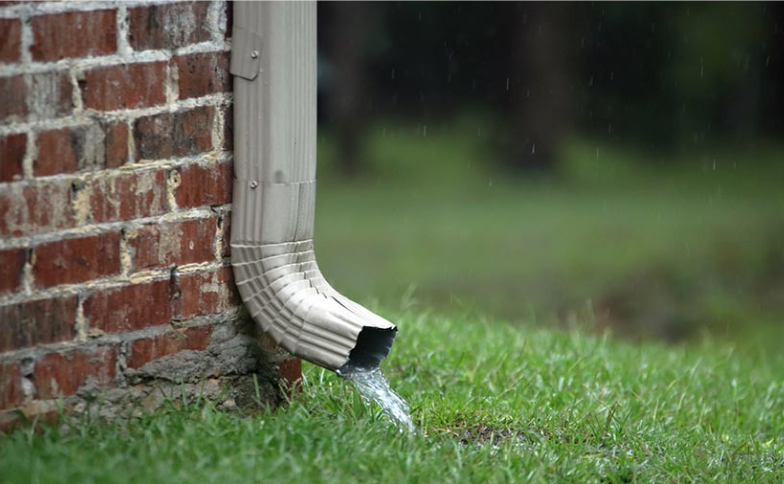
This is the question homeowners should be asking when looking at a downspout: where does this water go after it leaves the downspout? A downspout extension that sends water several feet away but leaves it sitting in a low spot hasn't accomplished much. A splash block that redirects water straight into a flower bed beside the foundation may simply relocate the problem rather than solving it. The goal is getting roof runoff onto a real drainage path where it can continue moving away from the structure — whether that means a longer above-ground extension, a properly sloped splash block, a buried solid drain line, a swale, some regrading, a connection to an appropriate drainage system, or some combination of these. The right solution genuinely depends on the specific property.
What Happens When a Downspout Dumps Too Close?
Imagine a typical Texas rainstorm — hundreds of gallons of water can come off a roof surprisingly quickly. A gutter collects that water and concentrates it into one relatively small discharge point, and without a proper extension, all that runoff gets deposited in the same spot beside the house, storm after storm. Over time, that pattern can lead to soil erosion at the discharge point, mulch displacement as soil washes away underneath it, standing water in low spots that stays wet after the rest of the yard has dried, saturated soil that stays consistently wetter than the surrounding ground, and drainage problems that push water toward the foundation instead of away from it. And sometimes the first visible sign isn't outside at all — it shows up as a crack or a sticking door somewhere inside the house.
Foundation Cracks Don't Automatically Mean You Need Foundation Repair
This is an important distinction. A homeowner notices a crack and assumes "my foundation is moving." Maybe — but a crack alone doesn't tell you what actually caused it. Foundation movement can have multiple potential causes, including soil movement, drainage conditions, plumbing leaks, settlement, expansive soil behavior, original construction conditions, structural changes over time, and other site-specific factors. That's exactly why a foundation diagnosis should come from an actual inspection rather than someone looking at a crack and guessing. Professional structural assessments in the Austin area regularly connect moisture diversion, runoff management, grading, and soil moisture consistency to structural movement — the drainage conversation and the foundation conversation are often the same conversation.
What About Homeowners Insurance?
This is where homeowners should be especially careful. A foundation problem does not automatically equal an insurance claim. Coverage depends on the specific policy, the cause of loss, applicable exclusions, endorsements, and the exact circumstances of the damage. The Texas Department of Insurance explains that homeowners claims can be denied when the policy simply doesn't cover the type of damage involved, and Texas insurance rules and historical policy forms contain specific provisions concerning foundation damage caused by certain types of water leakage — which illustrates exactly why the cause of foundation movement matters when evaluating coverage.
That's very different from concluding "your downspout caused your foundation problem, so insurance won't cover it." You shouldn't reach that conclusion without determining the actual cause and reviewing the specific policy. If you're concerned about a foundation issue, document the condition, have the cause properly evaluated, and talk with your insurance professional before assuming something is or isn't covered.
The Simplest Fix: Extend the Downspout
Sometimes the solution really is this simple. If your downspout currently ends six inches from the house, adding an extension can dramatically improve where that roof runoff actually lands. Depending on the property, an extension might run anywhere from a few feet to well beyond that, farther downslope. The correct length isn't determined by a magic number — it's determined by where the water actually needs to go to keep moving away from the structure rather than pooling somewhere just as problematic.
When an Above-Ground Extension Is Enough
An above-ground extension can make sense when there's adequate space beside the house, the ground slopes away naturally, the extension won't create a trip hazard, water has a clear destination, the discharge point won't cause erosion, and it doesn't interfere with walkways or landscaping. This is often the easiest solution to inspect and maintain — you can see whether it's still connected, see where the water exits, and quickly spot if it's been crushed, disconnected, or moved out of place.
When You May Need Something More
Sometimes there isn't enough room to simply run an extension across the yard — maybe there's a sidewalk in the way, the lot slopes toward the house, a neighboring property sits close by, or the discharge point falls in a narrow side yard. That's when a buried drainage system or regrading may make more sense. But buried drainage shouldn't simply mean "bury a pipe and forget about it" — the system needs a legitimate outlet or drainage destination, otherwise you're just moving the water underground instead of solving the problem. And in heavy clay soil, that's especially important: infiltration systems can be genuinely problematic near structures in heavy clay, since wetting that clay can contribute directly to foundation stress rather than relieving it.
Don't Create a New Problem With Your Drainage Fix
There's a temptation to solve every downspout problem with an underground French drain. That isn't always the right answer. If you bury a pipe without somewhere appropriate for the water to actually discharge, you haven't necessarily improved the site — you've just hidden the problem underground. Likewise, don't direct water toward the foundation, into a low spot, toward a neighboring property, against a retaining wall without proper drainage, or into an area that routinely stays saturated. The drainage system needs to work with the existing grade, not fight against it.
Check the Grade Around the House
Look at the soil immediately around your foundation. Does it generally slope away from the house? Does it look flat? Or, worse, does it slope toward the house? Positive grading away from the foundation is a foundational principle of good drainage design, and where adequate slope can't be achieved in a constrained area, directing water to a drain or swale becomes the alternative. This is exactly why a downspout problem sometimes isn't actually a downspout-only problem — you may have roof runoff, a short downspout, and negative grading all combining to collect water near the foundation. Fixing just one part of that equation may not solve the entire issue.
Watch for These Warning Signs
Walk around your house after a significant rain and look for water pooling near the foundation, especially if it remains after other parts of the yard have drained; soil washed away underneath a downspout, which can indicate concentrated runoff; mud or consistently wet soil in one area; cracked or separating soil, since large changes in soil moisture can produce visible changes in expansive soils; downspout extensions that have disconnected, which is surprisingly common; gutters overflowing, since an extension can't solve a gutter that isn't collecting and carrying water properly in the first place; and water that's visibly flowing toward the house rather than away from it — one of the biggest problems to address quickly.
Your Gutters Are Part of the Foundation Drainage System
Homeowners often think about gutters purely as a way to protect siding and landscaping. They do that — but gutters also control where a large amount of roof runoff ultimately lands. A properly functioning system collects roof water, carries it to the downspout, moves it away from the house, and discharges it onto an appropriate drainage path. That's exactly why gutter maintenance matters for foundation health, not just curb appeal: a clogged gutter can overflow against siding, a disconnected downspout can dump water beside the foundation, a missing extension can concentrate runoff too close to the house, and a poorly positioned discharge point can send water in exactly the wrong direction.
What Should You Do If You Already Have Foundation Cracks?
Don't start by assuming the downspouts caused them. Instead, photograph the cracks from a consistent distance so you can track any change over time. Photograph the exterior drainage too, documenting every downspout and where it actually discharges. Check the soil for standing water, erosion, and obvious grading problems. Check for plumbing issues, since a hidden plumbing leak can create a very different moisture problem than normal roof runoff. Get the appropriate evaluation — if the concern is genuinely structural, have the condition evaluated by an appropriately qualified professional rather than relying on a siding or gutter contractor to diagnose the foundation. And review your insurance policy if damage is suspected, without assuming coverage or denial based solely on the appearance of the crack.
A Small Fix That Can Prevent a Much Bigger Headache
It's tempting to put a precise dollar figure on a downspout extension, but prices vary by material, length, installation method, and whether you're dealing with an above-ground or buried system. The more important point is this: a small drainage correction can be genuinely inexpensive compared with investigating and repairing a larger water or foundation problem down the road. And you don't necessarily need an elaborate drainage system to get there. Sometimes the answer really is: clean the gutter, reconnect the downspout, add an extension, fix the grade. The trick is figuring out which one your specific property actually needs.
The Exact Distance Isn't Really the Point
If you remember one thing from this article, make it this: don't obsess over hitting one exact number for how far your downspout ends from the house. Instead, ask whether the roof water is being discharged far enough away — and in the right direction — to avoid creating a concentrated moisture problem around the foundation. On expansive clay, controlling moisture consistently around the foundation is what actually matters. That means keeping the gutters clean, keeping the downspouts connected, extending them far enough to reach a proper drainage path, maintaining positive grading, and never directing concentrated runoff into heavy clay right next to the house.
And if you're already seeing significant foundation movement, don't try to diagnose the cause from a downspout alone. Good drainage is one piece of protecting the exterior of your home — sometimes the simplest fix is also the one homeowners overlook the longest.
Frequently Asked Questions
How far should a downspout be from my foundation in Austin?
General guidance commonly recommends 5 to 10 feet, with clay soil favoring the longer end of that range. The exact distance matters less than whether the discharge point actually drains away from the house rather than pooling nearby.
Can a downspout too close to my house really cause foundation problems?
It can contribute to uneven soil moisture around the foundation, which is a recognized factor in foundation movement on expansive clay, though it's rarely the only cause. A proper evaluation is needed to determine the actual cause of any specific foundation issue.
Is a buried drainage pipe always better than an above-ground extension?
Not necessarily. A buried pipe without a proper outlet can simply move the problem underground. An above-ground extension is often easier to inspect and maintain, and it's frequently sufficient when there's adequate space and slope available.
Will homeowners insurance cover foundation damage caused by drainage problems?
It depends entirely on the specific policy, the actual cause of the damage, and applicable exclusions. Don't assume coverage or denial without reviewing your policy and determining the actual cause first.
How do I know if my yard's grading is contributing to drainage problems?
Look at the soil immediately around your foundation after a rain. If it's flat or sloping toward the house rather than away from it, that's a sign worth addressing alongside any downspout issues.
Does clay soil really make drainage more important than in other areas?
Yes. Expansive clay soils swell when wet and shrink when dry, and uneven moisture around a foundation on this soil type can contribute to differential movement in a way that's less pronounced in more stable, better-draining soils.
Can I fix a downspout drainage problem myself?
Simple fixes like adding a downspout extension or splash block are often manageable as a DIY project. More involved solutions like regrading or buried drainage systems typically benefit from professional evaluation and installation.
What's the difference between a downspout problem and a grading problem?
A downspout problem concerns where concentrated roof runoff is discharged. A grading problem concerns the overall slope of the yard. They often combine to create the same symptom — water collecting near the foundation — so both should be checked together.
Should I be worried if I see a small crack near my foundation?
Not automatically, but it's worth documenting and monitoring. A crack alone doesn't indicate the cause, and many foundation cracks have multiple possible explanations that require an actual evaluation to sort out.
How often should I check my downspouts and drainage?
A good habit is checking after any significant rain event, plus a general inspection each spring and fall, looking for disconnected extensions, standing water, erosion, and any signs of water flowing toward rather than away from the house.
Get Started With a Free Consultation
Good drainage is one piece of protecting the exterior of your home. If you're dealing with gutter, downspout, or exterior drainage concerns in the Austin area, we're happy to take a look.
Remember: When you refer a friend or neighbor for windows, siding, roofing, or door replacement, you can earn up to $250 through the JP Exteriors Referral Program.
Subscribe to JP Exteriors's Blog





Comments